Friday, December 15, 2017

What are You Resisting?


The US's political climate today is fraught with all kinds of contested space. Many of us who are not economically in the top 1%, white, male, or cisgendered, may find ourselves fighting against policies intended to benefit anyone but us. As a result, many political activists have joined together to form "The Resistance" to stem the tide of what seems to be a politcal effort to regress back into the social policies of the 1950s. Many are fighting for basic necessities such as clean water (Flint, MI), healthcare, and equal rights like marriage or voting.

And some are fighting *against* the plutocracy's outrageous and evil notions-- such as the efforts to reduce the land in National Parks, drilling in the pristine Arctic, destroying sacred Indian ancestral burial lands, or to kill net neutrality.  Despite some progressives' lamentations that one can't just be "against" the conservative agenda, but that we must be "for" something, resistance is absolutely critical in this era so that we don't just slip into fascism. 

The Trout Gallery
Sue Coe, You Consume Their Terror, 2011.
The question of "what are you resisting?" is a good one to ask when discussing political or social forces over which one needs to have a strategy. But it's also a good question for the artist to ask "what am I resisting within my practice? Is there something that I'm avoiding thinking about or doing?"

Are you resisting tackling a specific thing in your practice? What are the reasons? Are they valid reasons? Is your resistance a matter of not acquiring a skill set, or is it a resistance to navigating daunting logistics like money/ space/ or time?  Do you not enjoy a particular kind of subject matter because you have some kind of philosophical bias or emotional barrier to overcome to get there? 

My grad school mentors did a good job of breaking down our resistance to subject matter or physically challenging constraints like size or complexity. Inertia / laziness can be a mighty obstacle for some, but nothing can replace "ass in the seat time" for gaining important experience within one's practice. My own resistance against depicting babies or children, working large, and working without color, was broken down gradually so that I'm now able to ask myself whenever I feel like I'm dragging my feet about doing a particular thing, "against what and why am I being so stubborn?" From there I can analyze whether there are logistical problems for which I need to find a workable solution, lack of a particular skill set that needs to be acquired, or whether I'm experiencing some kind of bias in my thinking. And then I need to decide whether overcoming that obstacle is in the best interest of my sustained practice. (Usually the answer is yes).

Resistance to destructive social and political policies also provide the opportunity to make great art.

So what are you resisting?


Monday, December 11, 2017

So What's Wrong With Wanting to Do It All?

Not a thing.

Life is too damn short and, in my opinion, you only get one shot to do everything you can imagine.

Luckily, for we happy people who are called to make Art, everything we make or take on is an endeavor to express our unique position as artists and conduits of culture. Our ability to see beyond what already exists into the realm of "what could be" is our gift (or curse?) and the more avenues of expression we have, the more opportunities we have available to say what we need to say.

The past year for me has been... interesting, to say the least. I've been rediscovering my love of clay art, and it is reshaping my idea about what it means for me to be an artist in this life. Additionally, my serious foray into songwriting has opened up even more possibilities... I feel as if I'm in the most creative period of my life.

I did two shows this year, returning to ConGlomeration-- but as a potter; and was juried into a quirky local show called the Market of Curiosities. In addition to that, a local shop in York, PA, "Black Sheep Everything", has taken my pottery in on consignment and is selling the work. The reception I've received for it has been phenomenal and sales have been very good.

In learning more about search engine optimization, I changed the pottery site's name, rebranded it "Kest Pottery Studio" and finally bought a real domain name; you can take a look at it here:
www.kestpottery.com
Monsterpots!
Additionally, I'm exploring some older ideas that I'd generated when I was in my 20s: wall sculptures. I like to call them gargoyles because they remind me of the odd and amusing faces seen on cathedrals. In the past I'd sculpted them in clay that was only oven-dried, but it's more satisfying to fire them to a more permanent hardness. The storytelling aspect of the pieces is something I'd like to push further. Juxtapositions are interesting too:
Grumpy Gus and the noisy Crow

What is in store over the next year? We shall see. I already have a bunch of ideas to move beyond what I'm currently doing, with ambitions to combine my interest in 2-D storytelling with the clay art.

Generating new ideas to be able to sustain your art practice is the holy grail of being an artist. Older ideas carry over and are folded into the new; new materials can be a fresh way to explore older ideas and can generate entirely new work. I can't wait to see what comes of this in 2018!

Friday, October 21, 2016

Ass In the Seat Time

After almost 9 years of teaching illustration at the college level, I decided to leave it. I scheduled a sabbatical this fall because my busy freelance schedule was going to keep me hopping and thus, I didn't feel comfortable straddling both jobs. When spring looked to be equally busy, I decided that it was time to hang it up. Since I never considered myself at heart to be a career teacher, but a practicing studio artist, the choice was made even if it wasn't an easy one. I still love teaching and may consider returning to it at some future date, but I am at a point in my illustration career in which my practice is rejuvenated and that I feel my best and most exciting work is still ahead of me. Compound that with an interest in writing music and a keen interest in sculpting, and well, my choice got clearer.

That said, I still get email and in-person requests from nascent artists to teach them about technique, paint mixing, colors, anatomy, etc. "How do you do that thing, specifically?" "What is your secret to such-and-such a look to your paint, style, etc.", as they show me their portfolios full of their finished or WIP stuff. Of course I try to help as best as I can and give them the best critique to help guide them along the way. And then there are the virtual tons of tutorials online demonstrating digital or traditional media techniques.

Students in the classroom are in a similar mindset when they ask for a demonstration. Media and use are simple things to master and show. However, what I think they're really asking is "How do you know how that light/ shadow works? How do you know that that's the right color for that object? How did you arrive at that correct angle and foreshortening/ perspective of that anatomically correct figure?" All valid questions. All which can be answered with one thing: observation. James Gurney's books, Light and Shadow, and Imaginative Realism: How to Paint What Doesn't Exist, are excellent books on the topic of understanding how light and shadow works to define an object in space and how color works within this framework, how perspective works, etc. He also teaches the reader a bit about how to use reference properly and how to "paint out" that reference so that it looks like the artist gleaned information from reference rather than photocopied it.

How does Gurney know all of what he knows? He has been observing the real world around him for decades. He's a paleo-archaeologist, academic, and a scholar whose expertise goes beyond the world of illustration and encompasses several other disciplines. He's done a whole lot of thinking, and a whole lot of drawing and painting to process and codify that information in order to teach it.

Any other artist as ancient as Gurney (like me) began an art career pre-internet (or at least before we had access to it) where anybody who wanted to become an artist had to research his or her subject in reality-- ie. painting and drawing from actual live, real objects. Books were good  in a pinch but photographs are not adequate substitute for reality. If you wanted to draw pollen burrs, you walked through a un-mowed field and any burrs that stuck to your clothing, you observed and drew under a stereo-microscope. Or if you found a dead bird, you might place it in a cornfield and come back to it a week or so later to retrieve the skull to draw and paint it. If you wanted great color reference for a scorpion, you bought one at a "pet" store. I personally collect actual objects like these and have made drawings from live objects which allows me to light them as I wish so I can study it. I can turn it around in my hands (in the case of the scorpion, it was with forceps) and really look at it. Today's young artists are skipping that critical step of drawing from life because they can go to the internet and just download a photo.

This is why they are still asking how light/shadow works or how basic anatomy works.

Tutorials and demos, books and lectures, copying styles and techniques are not a bad thing to start with at the very beginning of one's journey. But what point does the young artist stop looking at tutorials, and just get down to the nitty gritty of just doing the work, of observing the real world firsthand, and then putting in the requisite "ass in the seat time" hours in order to develop those observational skills.  There is no shortcut here, folks. At some point, you've got to stop looking at tutorials and demos and just get to work. This time spent *practicing* builds your skill sets in observation, drawing, painting techniques. It also gives you the time to think about what you want to say and how you want to say it. Additionally, it builds your self-confidence in your work that is critical to growing a sustainable practice.


Thursday, December 17, 2015

So much has happened...

Well, I've been away from my blog for over a year now and a lot has happened.

The biggest thing to change with my work has been the addition of the digital medium to my practice. It's kind of revolutionized it. Not only can I work faster, but better. Yes, not only can I do three times as much work in the same space of time, but I can get back to some of the "details" that I'd let slide when my eyesight began to tank a few years ago. This became especially noticeable in the botanical work, where detail and accuracy is super important. The ability to "zoom" in on the image (without using a lens) made all the difference. (Thanks, Wacom!!) You can see more of the Old Farmer's Almanac 2016 Garden Calendar on my website.
Yep, digital rocks. (Yankee Publishing Co., /Kristin Kest)

Additionally, I made my first foray into the kids' graphic novel genre with New Worlds Publishing Co's, Lost In Dreams, Book 1, which is now out in ComiXology here.  
Lost In Dreams: the adventures of a girl and her dad in the world between dreams. 
Pirates, monsters, robots, spaceships, hints of demons, etc., what's not to like?

Working digitally meant that text, font, speech bubbles, layout, etc., was super easy.  Since I did all but write it, I needed as much help as I could possibly get. 100+ pages is a lot of work, but it was well worth it. Additionally, the experience of it all taught me so much about the genre and how it works.

But wait~ there's more! I "inherited" a pottery studio from a wonderful friend of mine. Elva and her husband John were moving and didn't want to take the studio with them. Elva is a potter and a poet with a doctorate in psychology (and a practice) and John is a writer-historian, professor emeritus in philosophy, and both are just amazingly wonderful people. They both have published books, which you can find here: Elva's book;  John's book. (I drew the illustrations for Elva's book.) Well, you can imagine the fun I've been having with the pottery studio and the clay. Here's just a sample from the summer's play:
Suspicious looking little fellas...
Another friend and I are going to be seeking local craft places to sell our wares in 2016. I am really looking forward to all of the possibilities! 


Friday, March 28, 2014

Endangered Animals

The original 1995 cover.
In 1995, Western Publishing Company published a Golden Guide called Endangered Animals. I was the artist who created all of the artwork on the inside spreads in addition to the cover. It was almost a year's worth of work and I loved every minute of it. The art director, Remo Cosentino, was a fantastic guy and taught me, a newbie illustrator, a lot about the business of creating books.  Unbeknownst to me, this book was to be among the last of that Golden Guide series to be published under the Western name, as the company was subsequently bought by St. Martin's Press in 1999, and then shortly thereafter was sold to Random House in 2001. 


The current cover.
In the ensuing melee of lawyers , moving vans, etc., that accompany the shift of one company's assets to another in a short period of time, all of the paintings for this book were lost. 

All seventy-five paintings. Lost. Gone. 

They were supposed to be returned to me as per the contractual agreement.
In the following years, my agent and I have in vain tried to locate anyone with any knowledge of the whereabouts of this group of paintings. 


So,  I send my plea out to the Internet: If anyone has any information about these lost paintings, I would surely appreciate knowing it.  It is my hope to eventually recover them.
A big thank you! 

Monday, January 13, 2014

"Forbidden Creature Virgin Whore"

In the summer of 2013, I was asked by a dance company based in Philadelphia, PA, to be creatively involved with their production of "Forbidden Creature Virgin Whore." Miller Rothlein is owned and operated by wife-husband team, Amanda Miller and Tobin Rothlein. Amanda is the creative director, choreographer, and general expert in putting together the works; Tobin is a filmographer and photographer. I'd met them both while Tobin and I were grad students at MICA in Baltimore, and was quite excited and pleased to be invited to participate.

So, you might think, what does a visual artist, illustrator, like me have to offer a dance production? Well, I asked myself the same question and expressed deep misgivings to Amanda when we first talked. I knew absolutely nothing about dance, I told her, and felt inadequate to the task. Amanda reassured me that while I knew nothing about the medium of dance, I was certainly qualified to consult with them on the storytelling as I'd done extensive research into the genre of fairy tale and mythology, and that my involvement in this would be perfect.

My fall schedule was so hectic that I only got to attend one of the rehearsals-- which blew me away. Amanda video-recorded subsequent rehearsals and sent them to me via shared online documents, and we chatted via phone about the meanings of the gestures and how each character would look and behave. Once we had a handle on the characters and their roles, the story grew organically. All that was left for me to do was to write an essay that expounded on the meaning of the piece and explained its story origins.

Here is the essay in its entirety. If you are moved to provide feedback, please do so.

Miller Rothlein’s Forbidden Creature Virgin Whore
4 Nov 2013

Paul Struck MIRO Spotlight
Paul Struck as the Forbidden Creature. Image by Tobin Rothlein.


Stories and myth have great potential and power, yet the stuff of fantasy is often dismissed as a banal and trivial pastime by academics and fine artists who insist that any serious pursuit of it is best left to children. However, fantasy is a place where the unnameable exists. When lives lack justice, the realm of the fantastic provides a place to experience psychic redress; it is a place where we can create imaginative ways to live in a hard world. Fantasy is the social safety valve when dangerous proclivities beckon. Children know this instinctively. Whole worlds of particular logic reside inside the mind that can distinguish truth from social construction. We build elaborate imaginative scaffolds to support our conclusions about the world, while ignoring hard evidence that would defy those perceptions. Our ability to bolt down stylized interpretations of reality means that we suppress our appreciation of ambiguity and individualized expression. The indelible nature of stories is a testament to this.


Any story, therefore, directly reflects the moral and philosophical mind of the writer, storyteller, or artist. It mirrors a reality, a truth that exists if only in imagined form, a truth nonetheless shaped by actual perception. Metaphors simplify the message, and the meaning can switch and swim through the centuries, ideologically aligned to the next storyteller’s social or political agenda. History is filled with this kind of cultural conquest; there is no better way to create cultural change than to write over a story’s bones with a different meaning.


Existing stories define a society, produce its identity, and reinforce group behaviors. Gender expression is one of those areas of human behavior that is rigorously policed, and in all traditions, tales of fiction are expressly used in a direct attempt to control sexual behavior. Archetypes, metaphors, and formulaic morphologies have always streamlined this effort, and sweeping generalizations function to predictably move the story forward. We wonder how we continue to be exposed to these particular efforts today if we ask: what does it mean that our male characters still must adhere to strict codes of masculine behavior? What does it mean that our female characters’ sexual natures still continue to fall within predictable and recognizable patterns of behavior? That we are living on the inside of the juggernaut hampers our ability to perceive the nuances between real gender expression and those which are shaped by social construction.  


In Forbidden Creature Virgin Whore, agency emerges as a primary force that drives each of the characters’ lives within the story arc. Each character, possessing varying degrees of agency and scope of influence, exerts the force of her/ his unique assets upon the other characters. The quality of the agency and how creatively each Archetypes can navigate within her/his proscribed roles determines the ability of our characters to move and function within the story arc. Limitations placed on human behavior produce interesting survival strategies as well as generate destructive behaviors and artificial competition between individuals. Once we set our Archetypes into motion with the initial interaction between “actives” determined by traditional stories, we can then experiment with the outcome. What does it mean for an Archetype to “play a role?” Does it need to step outside of that role in order to claim power? Can the roles be redefined, shifted? What is necessary to create the kind of outcome whereby the Archetypes can be broken and real expressions of gender can be made viable?


In our first Archetype of the duality-laden Virgin/Whore, the issue of threshold, crossing over from sexual ignorance to one of knowledge is a primary characteristic. The Virgin/Whore seems initially to have the least agency of the three female archetypes. Disadvantaged by youth and inexperience, her sexual potential is rigorously policed for fear that female pleasure should discover itself and become loosed for its own sake. This name of half of the Archetype could be any of the Disney franchise’s princesses; she is also Juliet or the Bride. Yet, the other side of the Archetype has plenty of hidden agency, revealed as a cunning survival strategy of manipulation. She is Hannah Montana-cum-Miley Cyrus and her female potency is a veiled threat to order, yet it is a crucial part of society’s usual functioning. Her moral strength lies in her ability to maneuver around the restrictions placed in her way. While she remains subject to the whims of masculine desire, she is also poised to find economic security and independence.


The Domestic Goddess is another dual Archetype-- again, at once glorified and bound; her responsibilities afford her some rights by virtue of a sanctioned status. She is the holy bitch who does all the chores; she is the eternal font of physical and emotional sustenance, the giver and indefatigable doer. Call her Supermom and she is Martha Stewart feeling justifiably superior to all other mere mortals in the domestic sphere. Put her in “binders full of women” and watch how corporate competition exacts a heavy price.  Call her the Beloved Servant and we see Scott Thorsen’s face surgically altered to become Liberace’s. The Domestic Goddess is the concubine and employee; her face reflects the power exerted upon her, yet exalted by virtue of the motherhood contract: the physical creation of children and community defines her as a fully-fledged member of society, and she is protected by its moral jurisdiction. The Madonna’s strength is in her endurance, love, and fierce devotion to her children and family, and her ability to suffer rejection and loss.


The Archetype who fiercely lives outside the socially accepted norm and for whom the standard life script will not do, is The Forbidden Creature. Armed with claws and awareness, she is dangerous because she lives her life deliberately on the margin of society. This is the loose cannon that bashes holes in the sides of the social construction and subverts the normal plot. Beware of the Vampire or the Wicked Witch, this creature will kill and consume; Joan of Arc will stubbornly choose immolation over having to wear a dress. It may turn herself or her prey into something unexpected. It does the unthinkable, the unacceptable, and for that offence, the traditional story often writes her into oblivion, yet the character functions as a sharp counterpoint to the story’s “norms”; she is the uncomfortable anomaly that exists to defy our perceptions. The Forbidden Creature’s goal is to live on its own terms, and its strategy is to know itself and its boundaries. It is the unimpregnable, unignorable, unfuckable She.


Finally, our male Archetype, Everyman, is our Prince Charming. The world is his oyster. He confidently, aggressively claims the space around him, unencumbered by any restraints on his libido. Everyman’s goal is conquest and his interactions with each female Archetype are driven by his insatiable sexual curiosity. Don Juan’s effect, while sowing his oats, is to sow the illusion of separateness and competition between the Archetypes as they all vie for attentions and favors. However, the success of Romeo’s encounter with each female Archetype is shaped by the agency each is granted; the more agency she possesses, the less power he has over her. Everyman’s tremendous agency is a two-edged sword: the gift that enables him to be the ultimate Bad Boy is also the very thing that suppresses his ability to truly emotionally connect. However, it is also the key that potentially allows him to subvert his paradigm and become the Hero.


The danger and delight is that we see these stories and Archetypes not merely as mental playthings to lightly entertain us but as real examples upon which to model our human behavior. The story’s power is in its synthesis of reality; it discards problematic details and exceptions for the sake of its internal logic. Human perception intuitively looks for coherence in much of the world even when it does not exist, which also means that people see the truth better when it is fictionalized. We can make use of this pattern-seeking tendency and bend the logic of a story to our own stated goals-- which is to break the stereotypes and create a plurality of expressions. We subvert the story by focusing on the personal strengths of each Archetype and amplify them so that the characters can grow and thrive. Each discovers what it needs to expand beyond the limits of his/ her roles, finding nuances in a gendered performance. The Virgin/Whore discovers her agency through female pleasure, the Domestic Goddess casts off that which binds her and sees what her creative powers can do, the Forbidden Creature becomes a uniter and teacher, secure in her Otherness, and Everyman begins to freely express his emotions. The liberation of each Archetype comes from shared agency and the willingness to connect and to honor ambiguities and differences.


*********
References


Jackson, Rosemary. Fantasy, The Literature of Subversion. Routledge, London, 1981.


Propp, Vladimir. Morphology of the Folktale. University of Texas Press; 2nd edition, 1968.


Zipes, Jack. Fairy Tales and the Art of Subversion. Psychology Press, 1991.

Daniel Kahneman, “The Marvels and Flaws of Intuitive Thinking,” Thinking: The New Science of Decision-Making, Problem-Solving, and Prediction, ed. John Brockman. Harper Perennial, 2013, pp 386.


Sunday, August 25, 2013

Potboilers

Your best work will not be produced via commission. Your best work will come from your own vision, undiluted by anyone else's input, and achieved from long uninterrupted hours at your easel. That said, we illustrators thrive on the crazy adrenaline rush of assignments that come at us in a flurry and fly out of our studios just as quickly, leaving us wild-eyed and tired with some money in our pockets. The commissioned project can give us a sense of accomplishment and pride but cannot in the long run sustain us or boost us to the next level of individual skill or personal idea formulation. Assuming that you desire a fulfilling art career in which you get to lavish your attention and manual skills on ideas and projects that you love, then you may want to rethink what projects you take on.

A career made of fast, short projects or uninspiring commissioned work will *never* allow an artist to really hone any rigorous painting or drawing skills other than perhaps how to cut corners for speed. Duh, right? Fast short projects can occasionally be a good exercise for making the illustrator to have to think quickly, sometimes producing clever results. However, this too can eventually go awry since those initially clever solutions can become gimmicky or produce cookie-cutter responses. We see this happening in a lot of the F+SF industry; when artists are asked to design, rough out, and execute a project in color within a few days, many of the solutions become formulaic. Much of the children's science and educational industry is geared towards this kind of production as well. Schedules are often so tight that artists adopt "styles" from whatever is trending in any given season. Fine artists, too, occasionally take on uninspiring commissions for quick income and do so to their own detriment when they allow the patron to dictate the outcome.

Young illustrators looking for quick entry into the industry, the promise of "getting one's feet wet", "exposure", or the feeling of "paying your dues" are always tempted by potboilers. Female illustrators are even more susceptible to falling into the potboiler trap and never getting out. The social reality of women's lives is that mothers' and caretakers' time doesn't often include long uninterrupted hours for big projects; small assignments can be completed in very short bursts and can tolerate incessant interruptions. In an industry like F+SF where rigorous painting and drawing skills are more valued and monetized, the potboiler trap may be greatly implicated as to why there are fewer women illustrators in this genre.

Almost all artists see potboilers as a pathway to "bigger and better things." What is this "bigger and better" thing? And can't we just skip right to it?

Potboilers don't pay all that well so the bar for quality is set a bit lower; the company isn't taking any real economic risks with these works. Depending on how fast you work, you may be able to crank out a dozen or more of these in a month's time in order to pay the bills. Month after month and year after year you may have your bills paid, but will you really satisfied with a career built on throwaway commissions? If you're not spending an equal amount of time on your own personal projects, then your *career* is eroding your artistic desire and you will eventually lose your artistic integrity.

I will say it again: short, fast, throwaway projects will *never* bump you up to the level of the "big players." Why? Because quick and dirty commissioned work is not the same thing as honing your skills or developing a sustained lifetime practice in art. Ask yourself: why did you get into this in the first place?

Better commissions pay more, have lengthier turnaround time, and offer the artist more say in the conceptual process. By paying the artist more, the company is taking more risk and investing in the artists' vision.These are rare commissions and seasoned illustrators are more likely to secure them. If you aren't able to get these commissions right now because you need to build up your "artistic vision capital" within the industry, then the bigger and better thing is having your own "fine art", personal work to do. It is better to spend your time working on your own ideas. stories, and developing a rigorous practice than to waste your time and effort on crappy commission work.

It is the luxury of time spent on a project that an artist needs most of all. Time to conceptualize an idea and plan out a series of images that best carry that idea. Time to grex and mull over the drawings and make revisions if necessary. Time to plan the color and value structure. Time to luxuriate in the medium. It is quality studio time only that will produce excellence in the artist.

Sunday, August 11, 2013

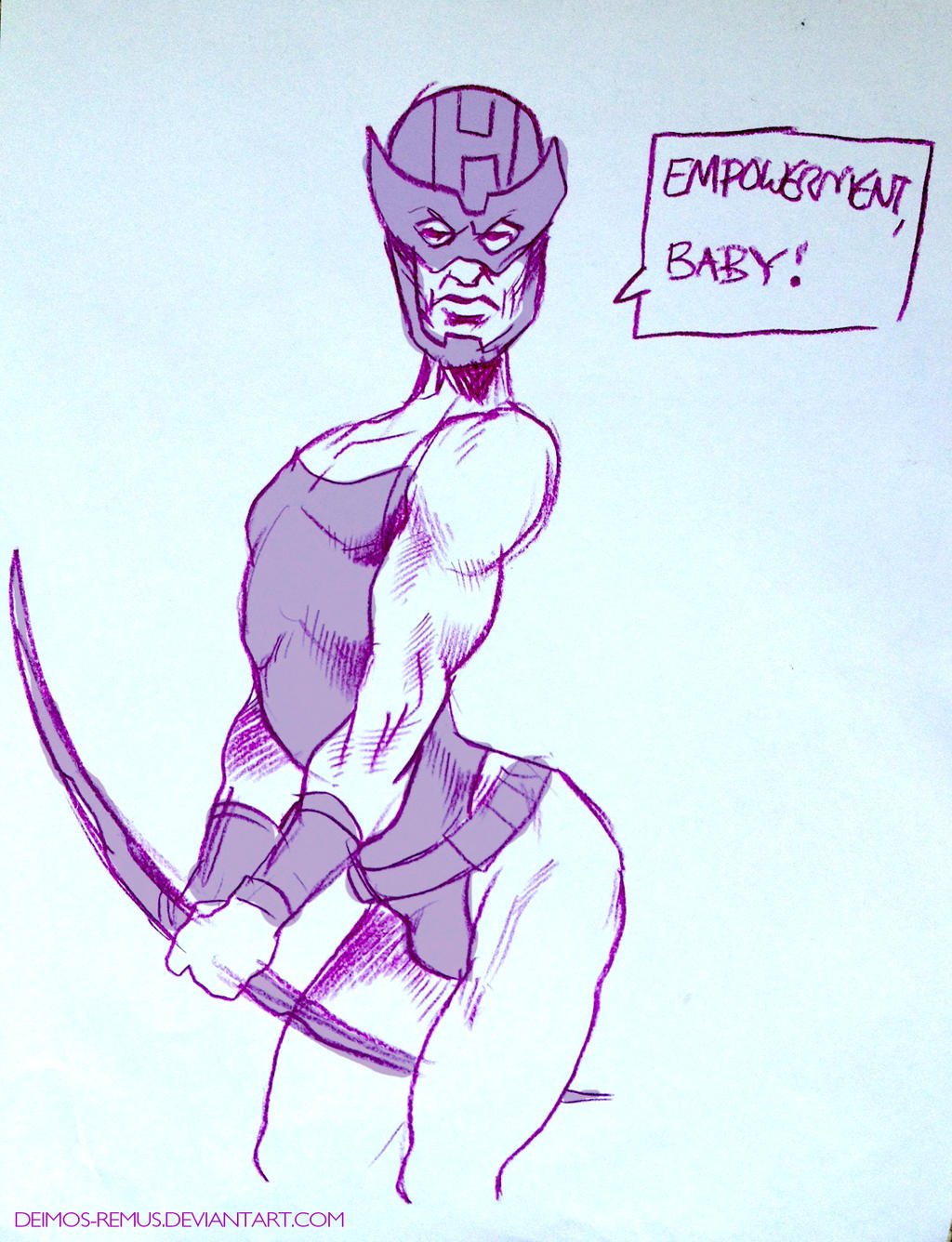
The Hawkeye Intiative

One of the most socially important memes out there is perhaps the genderflip, and one of the FUNNIEST collections of this strategy is contained in the site, The Hawkeye Initiative. The blog's premise is that in order to identify sexism in the comic book/ graphic novel industry, all one has to do is to flip the gender of the image portrayed. So, if a female superhero's "Strong Female Pose" looks a little suspicious, you can bet that if you put male superhero, Hawkeye, in her place its inherent sexism will be exposed...

Rob Liefeld's original.      My rendition.

                         Here, Avengelyne gets the Hawkeye treatment from artist Deimos-Remus on Deviantart.com. 
                                                                        "Owww... got to get to the chiropractor..."

What's really cool about this site is that it allows comic book lovers of all stripes to create their own artwork in response to the ridiculousness of what the industry is publishing, and upload that content (along with the original example) and add it to the site. In this way, it is a curated collection of images that exposes and isolates the sexism embedded and naturalized in the images, and educates the community of comic book viewers to what is really happening within the genre.When the viewer can bring her new awareness to her reading of these stories she can then commit to buying the comic books that already offer better representations of its female characters, and use her purchasing power to demand the industry to produce less-demeaning alternatives. It also offers the aspiring artist a lot of insight into how to authentically empower her own female characters.


       Gambit and the X-Ternals #1 cover       Hawkeye in an awkward stance, by Britt Roth
"Enter now... oof... I think my hip just went out...." (Gambit & The Externals/ Tony Daniels)

And more silly stuff. We humans are a funny lot. 

grodandor94:

Red Sonja Annual 4 cover by Jose Malaga
Parody by Jeffrey Dean
http://grodandor.deviantart.com/
"Wait! Don't shoot muh package..."  (Jose Malaga/ Jeffrey Dean)


You Don't Know How I Feel

If you are a female, having a career within the art world means that you will be confronted with several issues with which your male counterparts won't necessarily have to contend. To women working in the narrower field of illustration and the F+SF genre in particular, some of these issues are more glaring and others less obtrusive, but all still meriting our attention. Since inception in 1985, an anonymous band of feminist artists called The Guerilla Girls, have been bringing these issues to the fore with its sharp and funny insight into the corporate art institutions' sexist, racist, and corrupt practices and policies, The group has illuminated for over a generation what remains unfair and patently ridiculous about corporate arts culture.

Several of the issues that the group has identified are: unequal representation in museums and national shows, the almost complete lack of representation for artists of color, the fetishization / glamorization of violence against women, unequal pay in the marketplace (women artists earn only *1/3* of what male artists do), having to choose between a career and parenthood, being seen only as another's protege, reinforced hetero-normative values, having your work labeled as "feminine", and so on.

Ingres creepy extra-vertebrated creature gets a reboot.
Are any of these issues personally familiar to you?  You will have, as a female artist, person of color, or different sexual orientation, undoubtedly bumped up against some aspects of this culture at some point in your career. Many other illustrators who've worked in the publishing industry for any length of time will recognize many parallels in their own working sphere.

When we examine more closely the specific experiences of women illustrators working in the F+SF field, we find that many of these issues are simultaneously nullified and amplified.

Of the many artist friends with whom I've conversed about these issues admit to mostly having difficulties with spousal support of their career. Artists who are also parents are expected to automatically shoulder the domestic and child care duties in addition to busy careers, particularly if the spouse with whom s/he shares a household  is a higher wage earner.  Some aspiring young artists feel that they are inevitably faced with a choice of career vs motherhood, and decide to forego the latter entirely. Though partnered, these artists are still expected to attend to the daily household chores. Laundry, cleaning, shopping, cooking, etc., take a substantial chunk of time, time that could be spent on one's career.

And let's be honest for a moment: for a man, choosing a career in art it is thought to be his "calling." He is considered a professional artist. His wife becomes the high priestess in service to his mission, both of them working hard to ensure that he "makes it big" someday. But the reverse commitment is rarely true. A woman's choice to have an art career is not often heralded with equal enthusiasm and may be dismissed as only a dabbler, a dilettante. Oh dearie me, an art career? Well, you need to get married so someone can support your hobby. Yes, this double-standard really exists.

Persistent issues of fewer work hours, lack of domestic support, and general lack of emotional support of women's artistic endeavors are tied insidiously into the issue of lower pay. But add to this the industry's insult by way of "ghettoization' of women's creative work, and you have a perfect system that makes it incredibly more difficult for women to successfully establish themselves as professional creatives. That the publishing industry labels women's work as "feminine" and perceives it as a liability is a well-known fact. It is why many female authors choose male pen names and often write about male heroes and protagonists instead of female ones.

Some may say that the more disturbing aspect of swimming in these testosterone-filled waters, where the industry's profits come mostly from the discretionary money of white males 14-40,  is feeling that one must cave in to creating the work that the industry wants. Because gratuitous violence, aggrandizement of war, and gratuitous female nudity (masturbation melons?) is the bulk of we see in the comic book industry /F+SF, many of us conform to this industry standard by offering up the same kind of work, a general regurgitation of the sanctioned stories within the accepted formulas that has been in force since the genre was born.

Well, what's wrong with it? You might decide that it's perfectly okay to reinforce the status quo and perpetuate the sexualization of violence, misrepresentation (or entire lack of representation) of women and other people on the margins, the romanticization of specific gender roles, etc. You can do this by creating work that is exactly like what has been published for several generations in the western market.

Or you can do something more fun. You can subvert it. Use the form and turn it on its head.

Several contemporary realist painters offer some insight into how this might be done. In an earlier post, I mentioned the work of contemporary fantastic painter, Odd Nerdrum. I offer his work as an example of a classical, Renaissance-style painter who is not a romanticist. John Currin's another one. His beautifully rendered work, while amusing, is deeply disturbing in its candor. And Lisa Yuskavage's seductively grotesque work "one-ups masculinity" by amplifying the female body in all the right places, adding that touch of a soft romantic glow in the colors and value structure, yet the combination of her style and the content leaves the viewer feeling more than a little queasy about one's suddenly realized assumptions.

These painters have taken the traditional form of romanticist realist painting and subject matter (formal portraits, the fantastic-heroic, and sexuality) and have used it to subvert that which it was originally used to aggrandize. Their combinations of fantasy and realism help to drive home their message of the myth and how it depersonalizes. They insist that we take an uncomfortably close look at the ways in which we have fetishized ourselves.

Now that more women than ever are working as illustrators and artists, we have a big opportunity here to change the industry from the inside out. We are on the cusp of a big paradigm shift. Ours is one of the few industries in which its practitioners have actual first-person control over the ways in which we can represent ourselves and tell our stories. It's a huge advantage and we should make the best of it while we can and set some higher, better standards. Are you on board?

Sunday, August 4, 2013

The 99

Like superheroes and comics? How about multicultural ones? What if they're Muslim? In a world where certain ideologies are often twisted so that they are perceived as representative of one narrow and intolerant viewpoint, here's one astonishing and ambitious effort to change that.  Using the comic book platform, Naif Al-Mutawa's goal is to create a new moral framework within Islam for confronting evil. With his story of The 99, he and his team hope to "smash stereotypes and battle extremism" while entertaining its readers with stories of hope and positive moral lessons. Here, in this TED talk, Al-Mutawa explains his creative mission, drawing several comparisons to the creators of Superman:

http://www.ted.com/talks/naif_al_mutawa_superheroes_inspired_by_islam.html

Fighting the lack of multi-cultural representation within the comic book world industry since 2010...

 From TED:
Widad the Loving, Bari the Healer, Mumita the Destroyer and friends, all working together to fight evil -- the virtues of Islam are embodied in the characters of the thrilling new comic The 99. Naif Al-Mutawa, a clinical psychologist by training, created the characters with a team of artists and writers to showcase traditional, tolerant and enlightened Muslim values in the guise of good old-fashioned superheroes, ordinary mortals who acquire special powers and crisscross the globe on missions.
In a crossover comic series with the Justice League in 2010, The 99 were saving the world alongside all-American heroes like Superman, Batman, and a fully-clothed Wonder Woman. Al-Mutawa's creative team also launched an animated cartoon series on the US cable channel, The Hub.

Seeing that this is a comic inspired by Islam, you're not likely to see any representative LGBT characters-- but then, it's taken DC a while to out Batwoman. However, this is still quite an interesting and inspiring project that holds promise to be a good force in the world. 

Saturday, August 3, 2013

A Portfolio Strategy

If you're an aspiring illustrator and need to create a portfolio or you're tired of the one you've got and need to entirely revamp it, here's a tried-and-true strategy for building a portfolio fairly quickly within a year's time. This method also works for building a body of work for an upcoming gallery show:

1. Make a list of 100 wonderful image ideas. This list should be a fairly direct reflection of your aesthetics  and influences and what you want to look at. Love landscapes and natural places? Make a list of all the real and imagined places you'd like to "see" in paint. Love mythology and spirituality? Make a list of all the interesting deities and or arcana that you think would be cool to visualize. Love pirates and mermaids? ... You get it.

In doing this exercise, your content, if you didn't already know what it was, will begin to emerge through the subject matter. This is your theme, and more often than not it is a mashup of several things. For example, you may enjoy painting sweeping landscapes *and* women on horseback. This means that you are either interested in the Southwestern genre of painting or, changing a few of the details, perhaps the historical or fantasy genre. How realistically you paint, how much historical accuracy you engage in, can determine the philosophical direction in which you go.

2. Cherry-pick the best ideas and begin making sketches / drawings. Do this until you have at least 50 drawings. Some ideas will turn out to be duds and other, more innocuous ideas, may turn out to be spectacular. Keep drawing. Don't worry about anatomical accuracy yet. Don't use reference. At this stage you are only designing the idea and getting it directly out of your head and onto paper. You can go back later and grex over all the specifics and details. Work on standard 8 x 10 paper or similar-- not too big-- a sketchbook size. (If you're working on old-fashioned paper, be sure you love the feel of it. Suggestion: smooth vellum is awesome.) It may take you six months to work this out.

Yes, this will be the most difficult part of this process for most, but it gets easier once you begin to identify the creative elements that "move you" to make art in the first place. 50 drawings is really not such a crazy idea. You will need this many drawings in this mode of thinking - and perhaps more-- to get comfortable with who you are as an artist and what makes you tick. (If you're not a "linear" thinker and prefer value patches, then by all means, make small b&w studies in a different medium; the method will still work.)

3. Then, you will cherry-pick the top 10- 15 drawings to execute in color. Depending on the degree of finish that you gave the drawings, you may have to tighten them up. At this stage, bolt down any specifics for the painting, like value structure, anatomy, perspective, etc., so that your "blueprint" will be as effective as you need it. Refer often to artists whose color / facture work inspires and educates you.

That's it. Plan a year for this process, 6 months if you're fast. It works.
Have fun creating!


Saturday, July 20, 2013

The Chameleon

You're traveling with a fairly new friend in an unknown part of the country, through backwoods and small towns, and you stop for gas. It's the first time you've spent any extended period of time with this friend outside of the city for any reason and it is going pretty well.

350 miles later, you pull into a small station for a stretch break and fuel, and you head to the loo. When you return, you find that while you were gone she has been engaged in an extended conversation with the station owner who has pumped the gas and wiped the windshield. The weird thing, see, is that all of a sudden she has a thick country drawl that you've never heard before.

Ok, so maybe you admire the Chameleon's ability to "manipulate" people like this.  Perhaps you approve of the fact that they know how to "blend in" and make others comfortable by being like them. Perhaps you even ARE one of these chameleons.

The problem with the talented Mr. Ripley's strategy, apart from the fact that she cultivates a separate personality for each person she encounters, is that you don't really know the real person either because she has a "facet" for you too. You're just one more person in her conception of a particular "people model" that she emulates.

The bigger problem is that she may not even know who she is.

Unfortunately, this social chameleon model seems to have a counterpart in the art world: it is the artist who bends and flexes with what she thinks the industry wants. There are those who will say, "But, wait! The artist needs to acknowledge and fit into what the industry is doing! The artist must bend to the desires of the audience or they will never sell / be hired for anything!"

Is this true, or is it pandering? And is it even possible to be sui generis in an age whereby digital images of everyone's work constantly bombards us from all corners of social media?

The aspiring artist wants to be the greatest thing to hit the genre, and in her effort will latch on to what she thinks is the hottest trend that the industry is currently hawking. (Mermaids, anyone?) She will try to reproduce what her favorite artist(s) is doing and so becomes a copy-cat. However, the industry is rife with copycats, all trying on the "new thing," but, in the end they all end up, ironically, losing whatever uniqueness that may have allowed their work to stand out in the first place.  The work becomes just an echo of someone else's.

Start out by doing something different. Challenge the industry with your conceptions of what it -- and the world-- should look like.

A Case for College

You've already heard the argument that college is a waste of time and money for aspiring artists, but I would like to make the case for going to college. College--not art school.

Elsewhere in the blogosphere, some have proposed alternative educational methods and materials to achieve the technical skills necessary to work in the illustration field. For the cost of a few thousands of dollars, you can buy art books, seminars, classes with the "masters" and summer mentoring; they declare that an illustrator in the biz can be self-taught and fairly proficient after a period of dedicated work towards a professional portfolio. There are, indeed, a few big name illustrators who are self-taught and are living proof that this method can work. But, is this proof of the method itself, or is their success more a testament to their unique creative brilliance and sophistication? I would wager that even they would say that mere technical proficiency is not enough. It is not a guarantee of success even if you work your ass off.

So why would any aspiring artist go to college, spend all that moolah when she can get similar technical instruction on her own for a fraction of the cost of a brick and mortar school?

Because technical instruction isn't the same as developing a philosophy for a viable art practice.

(For the sake of full disclosure, I *do* indeed teach at a college, and so you may think my bias is economically driven, but that is absolutely nowhere near the reason for my argument.)

I was a self-taught illustrator for almost a decade before I decided to go back to school at 30. Part of not attending college sooner wasn't for lack of interest but more a lack of funds and time-- and, admittedly, some of it was bias against the "institution" of college. In that time, I had absorbed the art books, developed the technical skills, and had a ton of experience under my belt, but after almost ten years in the industry, doing the same work over and over again, it was obvious why I was so unhappy. With my practice no longer emotionally sustainable, college offered me an opportunity to study something new so I could get out of illustration purgatory.

So, my plan was to go to school, absorb all of the technical stuff for a job in another field, and begin to map out a new direction, maybe start at the bottom again somewhere in a lab...

And then the unexpected happened.

The introverted, socially oblivious, and ridiculously naive person that I was discovered that my real, actual life was more than just mastering a technical skill set and committing to memory random bits of esoteric trivia. Life is about being able to generate new and interesting ideas. Life, Art is critical thinking.

I devoured Philosophy, Ecology, History, Genetics, Feminist theory, and other disciplines, and these were intriguing to me merely for their own sake. But it suddenly dawned on me that these courses were the missing pieces of my art practice. Feminist theory specifically, helped me to develop the personal lens through which I was able to see how these seemingly disparate "other" kinds of study were crucial to making art. This discovery of the principle of integration is what changed my perspective about remaining as an artist; it is what allowed me to find my artistic "voice."

Besides developing the philosophical aspect of my work, It was the social experience that taught me more about what artistic skill levels I'd need to cultivate overall to move out of my stagnation and to reincarnate my art career. I found a whole host of interesting non-artists with whom I could associate: future scientists, musicians, actors, my professors, business students, accountants, nurses, all of whom shared their different and interesting thoughts and perspectives with me. Swimming in this milieu taught me more about human communication (verbal and non-verbal), the power of stories, and basic interconnectedness than I ever could have gotten in my own introverted bubble.

The technical fast-track, short-term quick-fix may put you in a career as an illustrator, but it takes more than that to create a sustainable art practice.

Is Fantasy Escapism?

I was at a women's symposium in Penn State in 2011, and after my talk, one of the lecture attendees asserted that F+SF is just plain "escapism." "Why," she asked, should we as feminists consider this [F+SF genre] as serious? What does it do for us except provide young people (read: males) with a means for fantasizing about sex? It is just a means for escaping reality!" Thus, to her, F+SF was a bad thing to be avoided and dismissed.

Recently, a young artist friend of mine writing to me expressed the opposite sentiment and illuminated for us the great utility of the genre: fantasy literature and art provided her a means of mental escape during a violent and ugly childhood. However, her current definition of the genre's use still extends mainly to cover what we might consider the typical-beautiful -- the light-filled, innocent, colorful images that populate children's books and fairy tales. That her use of it didn't go so far to include the genre's typical-horror (such as the work of popular HR Giger, designer of the Aliens trilogy) means that F+SF, like any art, is experienced through the subjectivity of one's own life.

These views are not unanticipated. To the first woman's complaint, I point in the direction of my friend's statement: the genre does indeed provide a place for escape from "the real world." As Jack Zipes has written in his book, Fairy Tales and the Art of Subversion, the fantasy genre has long been the place whereby the storyteller (writer) and listeners (readers) generate a certain psychic outcome for a reality that seems to lack justice. In early western Europe's era of feudal rule, where law and justice was a random occurrence, life was hard and bleak. Obtaining a just outcome for a wrongdoing was often not possible, so redress was sought by other means. Fairy tales and fantasy satisfied the need to feel that the world was right somehow and that life was worth living.

The main thing that I pointed out to the woman at the conference was that the genre provides an imagined space for safe existence. In addition to providing a child an emotional escape to a better family life that was full of love instead of pain, the F+SF genre was also home to the early underground LGBT movement: the mass market Pulp Fiction paperback genre during the 40s and 50s is yet another perfect example of the way in which this genre functions to allow that element which doesn't exist; for the unnamed, it is a place to be.

If we extend these rights to all seekers of the unimagined, then we must admit the less attractive underbelly of F+SF also lives there. All of this too, has a function, which I've discussed elsewhere on this blog.

The woman at the conference saw F+SF as just a haven for the unexamined privilege of a ruling class. While her assessment is absolutely right, the face of it is rapidly changing as the digital world democratizes the medium. This also means that there are more audience members, thus more eyes on monitoring the edges of the social contract and contributions made within all aspects of speculative fiction.

One last thought: imagining a better world for people doesn't mean you need to sugar-coat it. Children, in particular, deserve to know the truth of our world so that they can negotiate their way through it and out of harm's way. Safety of the escape doesn't mean that one turns one's back on the truth; it just means that one has to find ways to deal with it, let it out, find coping mechanisms for the ugliness. It means to find ways to not succumb to the darkness, but confront it, identify it, name it, and show it in all of its terrible aspects. This is how we can, as a social species, take evil's power away and reclaim it for the good.

Finally "Making It"

Those of us who enter any field of the arts recognize the phrase "making it." This is usually centered around the idea that once you gain a certain momentum in your work, that you've "made it." In the illustration field, it's about "breaking in," which means getting freelance work in the publishing industry.

For most aspiring artists, it's about being able to quit the boring day job and working full time at one's art. Others put a price tag on the achievement; making X dollars per year is the goal. For some it's all about recognition from one's peers and winning certain industry accolades. How do you define it?

I had a revelation recently that defines it yet another way. What if "making it" has nothing at all with the industry? What if it's purely about one's own satisfaction? What if it's only about the doing?

My own trajectory of "breaking into the field" long ago included a speedy 3-day transition from my day job as a house cleaner when I promptly got 2 books upon submitting my work to publishers (my first of many self promotional forays). Working in the children's science and educational market under the auspices of a well-known NYC agent, I began to define "making it" as not just being able pay my regular bills, but to have a "comfortable" life, ie. economic padding beyond an emergency fund.  After a decade of trying to get ahead, I became unhappy with my meager income, so I worked even harder; I hustled taking on more and more projects, really anything my agent set me (minus work from overtly religious institutions). I worked smarter, streamlining my technical skills even more, shortening the amount of seat time with time-saving strategies in design and facture.

Still, it wasn't enough.

I began to see that much of my frustration was borne of boredom with the science market. After 1000 or so paintings of Monarch butterflies, 1000s of paintings of the same big African Safari / Arctic/ Jungle fauna, 100s of images of the same species of flower under one's belt, one finds that one has painted them in every permutation possible --and then one begins to question the sanity of an industry that only uses certain commodifiable species over and over to generate its consumer base. It became imperative for me to get out.

According to my standards, I was no longer "making it" and this played havoc with my self-esteem. I felt like I was a failure. But at what? I was voluntarily leaving behind 20 years of clients and a solid reputation, but decided to strike out and try to "break into" another part of the illustration industry.

So, starting over....

Three years later, after having transitioned into to the F+SF genre, I am happier with my subject matter;  I am rejuvenated spiritually and my illustration practice is sustainable again. Teaching part-time at a local college, too, provides me with an important academic outlet that was missing. The additional income as an adjunct prof relieves the pressure on having to sell my soul; I can be choosy about what projects I accept as a freelancer. The bigger struggle, however, has been to redefine what it means for me to be "making it." No longer can I tie it to money or being completely self-employed, because teaching is something that I truly love and now wouldn't want to give that up. Neither can I tie it to recognition because I've walked away from those clients who used to ask for me by name. For me, real success-- making it-- has become the freedom to pick and choose the projects that I want to do. It means having the time to produce my own self-generated work in which my voice and my ideas are clearly represented.

How freeing.

Not surprisingly, "making it" has nothing to do with money, industry recognition, etc. It never has. It has to do with making the work. Yes, that's right. Every day that you get up and do your work is making it. When you come home from your day job, shut the door to your studio and get to work, that is making it.  When you produce something that you love, that is making it.

When it comes down to what you really get from art, you will find that there is no other substitute.

Sunday, July 7, 2013

Odd Nerdrum

If you're an F+SF artist and you're not yet familiar with the great Scandinavian figure painter and fine artist, Odd Nerdrum, you're missing out on something great.  Nerdrum's work has a great affinity for the painting style the quality of timelessness that is contained in the works of Rembrandt, Civilius, Caravaggio, and Goya, and yet it is contemporary work.
 Self Portrait With Melting Eyes


"If you compare yourself with others, you lose - I am the hero in my own life." ~Odd Nerdrum, 1983.

Nerdrum's early work has a Modern/ Postmodern sensibility in that it deals with contemporary issues and modern settings, but that is where the work's art historical context ends. Because his work maintains painting as its modality, it aligns itself more closely with the spiritual and ideological underpinnings of Renaissance painters, employing such dramatic chiaroscuro lighting techniques of Caravaggio. His later work flirts with the artistic symbolist sensibilities of William Blake. However, telling the story of the human condition remains the insistent content of the work:
Odd Nerdrum THe Murder of Andreas Baader 1977
The Murder of Andreas Baader, 1977.
There is a turning point in his work whereby Nerdrum finds his particular voice.  Homey Scandinavian themes with Vikings now abound, and yet with this kitschy subject matter he has put his finger on a general aspect of humanity. He's tapped into the uncanny: a strange yet familiar feeling; scenes of twisted humans interacting with one another. Timelessness. These smells and human groupings are familiar to us.
Odd Nerdrum. The Water Protectors (1985)
The Water Protectors, 1985
"On the surface we are all profound and noble, but inside we are cruel and simple." ~Odd Nerdrum, 2007.

Here he humanizes and personalizes the simple mythology of Narcissus with a sweeping design that is simple and compelling:


Sole Morte, 1987

Nerdrum works with live models, friends, relatives, and often himself, which lends the images a certain continuity of form; these characters come from the same filtered, imagined universe. Here is another unusual and arresting composition, again using the power of three:
Man Bitten By A Snake, 1992

More of Odd Nerdrum's work can be found here http://nerdrummuseum.com/paintings/.

[Ed. note: several image links were broken and so this page was updated on 21 Oct 2016.]