 |
| Art by Melanie Gillman |
Showing posts with label fine art. Show all posts
Showing posts with label fine art. Show all posts
Tuesday, August 20, 2013

Sunday, August 11, 2013
You Don't Know How I Feel
If you are a female, having a career within the art world means that you will be confronted with several issues with which your male counterparts won't necessarily have to contend. To women working in the narrower field of illustration and the F+SF genre in particular, some of these issues are more glaring and others less obtrusive, but all still meriting our attention. Since inception in 1985, an anonymous band of feminist artists called The Guerilla Girls, have been bringing these issues to the fore with its sharp and funny insight into the corporate art institutions' sexist, racist, and corrupt practices and policies, The group has illuminated for over a generation what remains unfair and patently ridiculous about corporate arts culture.
Several of the issues that the group has identified are: unequal representation in museums and national shows, the almost complete lack of representation for artists of color, the fetishization / glamorization of violence against women, unequal pay in the marketplace (women artists earn only *1/3* of what male artists do), having to choose between a career and parenthood, being seen only as another's protege, reinforced hetero-normative values, having your work labeled as "feminine", and so on.
Are any of these issues personally familiar to you? You will have, as a female artist, person of color, or different sexual orientation, undoubtedly bumped up against some aspects of this culture at some point in your career. Many other illustrators who've worked in the publishing industry for any length of time will recognize many parallels in their own working sphere.
When we examine more closely the specific experiences of women illustrators working in the F+SF field, we find that many of these issues are simultaneously nullified and amplified.
Of the many artist friends with whom I've conversed about these issues admit to mostly having difficulties with spousal support of their career. Artists who are also parents are expected to automatically shoulder the domestic and child care duties in addition to busy careers, particularly if the spouse with whom s/he shares a household is a higher wage earner. Some aspiring young artists feel that they are inevitably faced with a choice of career vs motherhood, and decide to forego the latter entirely. Though partnered, these artists are still expected to attend to the daily household chores. Laundry, cleaning, shopping, cooking, etc., take a substantial chunk of time, time that could be spent on one's career.
And let's be honest for a moment: for a man, choosing a career in art it is thought to be his "calling." He is considered a professional artist. His wife becomes the high priestess in service to his mission, both of them working hard to ensure that he "makes it big" someday. But the reverse commitment is rarely true. A woman's choice to have an art career is not often heralded with equal enthusiasm and may be dismissed as only a dabbler, a dilettante. Oh dearie me, an art career? Well, you need to get married so someone can support your hobby. Yes, this double-standard really exists.
Persistent issues of fewer work hours, lack of domestic support, and general lack of emotional support of women's artistic endeavors are tied insidiously into the issue of lower pay. But add to this the industry's insult by way of "ghettoization' of women's creative work, and you have a perfect system that makes it incredibly more difficult for women to successfully establish themselves as professional creatives. That the publishing industry labels women's work as "feminine" and perceives it as a liability is a well-known fact. It is why many female authors choose male pen names and often write about male heroes and protagonists instead of female ones.
Some may say that the more disturbing aspect of swimming in these testosterone-filled waters, where the industry's profits come mostly from the discretionary money of white males 14-40, is feeling that one must cave in to creating the work that the industry wants. Because gratuitous violence, aggrandizement of war, and gratuitous female nudity (masturbation melons?) is the bulk of we see in the comic book industry /F+SF, many of us conform to this industry standard by offering up the same kind of work, a general regurgitation of the sanctioned stories within the accepted formulas that has been in force since the genre was born.
Well, what's wrong with it? You might decide that it's perfectly okay to reinforce the status quo and perpetuate the sexualization of violence, misrepresentation (or entire lack of representation) of women and other people on the margins, the romanticization of specific gender roles, etc. You can do this by creating work that is exactly like what has been published for several generations in the western market.
Or you can do something more fun. You can subvert it. Use the form and turn it on its head.
Several contemporary realist painters offer some insight into how this might be done. In an earlier post, I mentioned the work of contemporary fantastic painter, Odd Nerdrum. I offer his work as an example of a classical, Renaissance-style painter who is not a romanticist. John Currin's another one. His beautifully rendered work, while amusing, is deeply disturbing in its candor. And Lisa Yuskavage's seductively grotesque work "one-ups masculinity" by amplifying the female body in all the right places, adding that touch of a soft romantic glow in the colors and value structure, yet the combination of her style and the content leaves the viewer feeling more than a little queasy about one's suddenly realized assumptions.
These painters have taken the traditional form of romanticist realist painting and subject matter (formal portraits, the fantastic-heroic, and sexuality) and have used it to subvert that which it was originally used to aggrandize. Their combinations of fantasy and realism help to drive home their message of the myth and how it depersonalizes. They insist that we take an uncomfortably close look at the ways in which we have fetishized ourselves.
Now that more women than ever are working as illustrators and artists, we have a big opportunity here to change the industry from the inside out. We are on the cusp of a big paradigm shift. Ours is one of the few industries in which its practitioners have actual first-person control over the ways in which we can represent ourselves and tell our stories. It's a huge advantage and we should make the best of it while we can and set some higher, better standards. Are you on board?
Several of the issues that the group has identified are: unequal representation in museums and national shows, the almost complete lack of representation for artists of color, the fetishization / glamorization of violence against women, unequal pay in the marketplace (women artists earn only *1/3* of what male artists do), having to choose between a career and parenthood, being seen only as another's protege, reinforced hetero-normative values, having your work labeled as "feminine", and so on.
 |
| Ingres creepy extra-vertebrated creature gets a reboot. |
When we examine more closely the specific experiences of women illustrators working in the F+SF field, we find that many of these issues are simultaneously nullified and amplified.
Of the many artist friends with whom I've conversed about these issues admit to mostly having difficulties with spousal support of their career. Artists who are also parents are expected to automatically shoulder the domestic and child care duties in addition to busy careers, particularly if the spouse with whom s/he shares a household is a higher wage earner. Some aspiring young artists feel that they are inevitably faced with a choice of career vs motherhood, and decide to forego the latter entirely. Though partnered, these artists are still expected to attend to the daily household chores. Laundry, cleaning, shopping, cooking, etc., take a substantial chunk of time, time that could be spent on one's career.
And let's be honest for a moment: for a man, choosing a career in art it is thought to be his "calling." He is considered a professional artist. His wife becomes the high priestess in service to his mission, both of them working hard to ensure that he "makes it big" someday. But the reverse commitment is rarely true. A woman's choice to have an art career is not often heralded with equal enthusiasm and may be dismissed as only a dabbler, a dilettante. Oh dearie me, an art career? Well, you need to get married so someone can support your hobby. Yes, this double-standard really exists.
Persistent issues of fewer work hours, lack of domestic support, and general lack of emotional support of women's artistic endeavors are tied insidiously into the issue of lower pay. But add to this the industry's insult by way of "ghettoization' of women's creative work, and you have a perfect system that makes it incredibly more difficult for women to successfully establish themselves as professional creatives. That the publishing industry labels women's work as "feminine" and perceives it as a liability is a well-known fact. It is why many female authors choose male pen names and often write about male heroes and protagonists instead of female ones.
Some may say that the more disturbing aspect of swimming in these testosterone-filled waters, where the industry's profits come mostly from the discretionary money of white males 14-40, is feeling that one must cave in to creating the work that the industry wants. Because gratuitous violence, aggrandizement of war, and gratuitous female nudity (masturbation melons?) is the bulk of we see in the comic book industry /F+SF, many of us conform to this industry standard by offering up the same kind of work, a general regurgitation of the sanctioned stories within the accepted formulas that has been in force since the genre was born.
Well, what's wrong with it? You might decide that it's perfectly okay to reinforce the status quo and perpetuate the sexualization of violence, misrepresentation (or entire lack of representation) of women and other people on the margins, the romanticization of specific gender roles, etc. You can do this by creating work that is exactly like what has been published for several generations in the western market.
Or you can do something more fun. You can subvert it. Use the form and turn it on its head.
Several contemporary realist painters offer some insight into how this might be done. In an earlier post, I mentioned the work of contemporary fantastic painter, Odd Nerdrum. I offer his work as an example of a classical, Renaissance-style painter who is not a romanticist. John Currin's another one. His beautifully rendered work, while amusing, is deeply disturbing in its candor. And Lisa Yuskavage's seductively grotesque work "one-ups masculinity" by amplifying the female body in all the right places, adding that touch of a soft romantic glow in the colors and value structure, yet the combination of her style and the content leaves the viewer feeling more than a little queasy about one's suddenly realized assumptions.
These painters have taken the traditional form of romanticist realist painting and subject matter (formal portraits, the fantastic-heroic, and sexuality) and have used it to subvert that which it was originally used to aggrandize. Their combinations of fantasy and realism help to drive home their message of the myth and how it depersonalizes. They insist that we take an uncomfortably close look at the ways in which we have fetishized ourselves.
Now that more women than ever are working as illustrators and artists, we have a big opportunity here to change the industry from the inside out. We are on the cusp of a big paradigm shift. Ours is one of the few industries in which its practitioners have actual first-person control over the ways in which we can represent ourselves and tell our stories. It's a huge advantage and we should make the best of it while we can and set some higher, better standards. Are you on board?
Saturday, August 3, 2013
A Portfolio Strategy
If you're an aspiring illustrator and need to create a portfolio or you're tired of the one you've got and need to entirely revamp it, here's a tried-and-true strategy for building a portfolio fairly quickly within a year's time. This method also works for building a body of work for an upcoming gallery show:
1. Make a list of 100 wonderful image ideas. This list should be a fairly direct reflection of your aesthetics and influences and what you want to look at. Love landscapes and natural places? Make a list of all the real and imagined places you'd like to "see" in paint. Love mythology and spirituality? Make a list of all the interesting deities and or arcana that you think would be cool to visualize. Love pirates and mermaids? ... You get it.
In doing this exercise, your content, if you didn't already know what it was, will begin to emerge through the subject matter. This is your theme, and more often than not it is a mashup of several things. For example, you may enjoy painting sweeping landscapes *and* women on horseback. This means that you are either interested in the Southwestern genre of painting or, changing a few of the details, perhaps the historical or fantasy genre. How realistically you paint, how much historical accuracy you engage in, can determine the philosophical direction in which you go.
2. Cherry-pick the best ideas and begin making sketches / drawings. Do this until you have at least 50 drawings. Some ideas will turn out to be duds and other, more innocuous ideas, may turn out to be spectacular. Keep drawing. Don't worry about anatomical accuracy yet. Don't use reference. At this stage you are only designing the idea and getting it directly out of your head and onto paper. You can go back later and grex over all the specifics and details. Work on standard 8 x 10 paper or similar-- not too big-- a sketchbook size. (If you're working on old-fashioned paper, be sure you love the feel of it. Suggestion: smooth vellum is awesome.) It may take you six months to work this out.
Yes, this will be the most difficult part of this process for most, but it gets easier once you begin to identify the creative elements that "move you" to make art in the first place. 50 drawings is really not such a crazy idea. You will need this many drawings in this mode of thinking - and perhaps more-- to get comfortable with who you are as an artist and what makes you tick. (If you're not a "linear" thinker and prefer value patches, then by all means, make small b&w studies in a different medium; the method will still work.)
3. Then, you will cherry-pick the top 10- 15 drawings to execute in color. Depending on the degree of finish that you gave the drawings, you may have to tighten them up. At this stage, bolt down any specifics for the painting, like value structure, anatomy, perspective, etc., so that your "blueprint" will be as effective as you need it. Refer often to artists whose color / facture work inspires and educates you.
That's it. Plan a year for this process, 6 months if you're fast. It works.
Have fun creating!
1. Make a list of 100 wonderful image ideas. This list should be a fairly direct reflection of your aesthetics and influences and what you want to look at. Love landscapes and natural places? Make a list of all the real and imagined places you'd like to "see" in paint. Love mythology and spirituality? Make a list of all the interesting deities and or arcana that you think would be cool to visualize. Love pirates and mermaids? ... You get it.
In doing this exercise, your content, if you didn't already know what it was, will begin to emerge through the subject matter. This is your theme, and more often than not it is a mashup of several things. For example, you may enjoy painting sweeping landscapes *and* women on horseback. This means that you are either interested in the Southwestern genre of painting or, changing a few of the details, perhaps the historical or fantasy genre. How realistically you paint, how much historical accuracy you engage in, can determine the philosophical direction in which you go.
2. Cherry-pick the best ideas and begin making sketches / drawings. Do this until you have at least 50 drawings. Some ideas will turn out to be duds and other, more innocuous ideas, may turn out to be spectacular. Keep drawing. Don't worry about anatomical accuracy yet. Don't use reference. At this stage you are only designing the idea and getting it directly out of your head and onto paper. You can go back later and grex over all the specifics and details. Work on standard 8 x 10 paper or similar-- not too big-- a sketchbook size. (If you're working on old-fashioned paper, be sure you love the feel of it. Suggestion: smooth vellum is awesome.) It may take you six months to work this out.
Yes, this will be the most difficult part of this process for most, but it gets easier once you begin to identify the creative elements that "move you" to make art in the first place. 50 drawings is really not such a crazy idea. You will need this many drawings in this mode of thinking - and perhaps more-- to get comfortable with who you are as an artist and what makes you tick. (If you're not a "linear" thinker and prefer value patches, then by all means, make small b&w studies in a different medium; the method will still work.)
3. Then, you will cherry-pick the top 10- 15 drawings to execute in color. Depending on the degree of finish that you gave the drawings, you may have to tighten them up. At this stage, bolt down any specifics for the painting, like value structure, anatomy, perspective, etc., so that your "blueprint" will be as effective as you need it. Refer often to artists whose color / facture work inspires and educates you.
That's it. Plan a year for this process, 6 months if you're fast. It works.
Have fun creating!
Saturday, July 20, 2013
The Chameleon
You're traveling with a fairly new friend in an unknown part of the country, through backwoods and small towns, and you stop for gas. It's the first time you've spent any extended period of time with this friend outside of the city for any reason and it is going pretty well.
350 miles later, you pull into a small station for a stretch break and fuel, and you head to the loo. When you return, you find that while you were gone she has been engaged in an extended conversation with the station owner who has pumped the gas and wiped the windshield. The weird thing, see, is that all of a sudden she has a thick country drawl that you've never heard before.
Ok, so maybe you admire the Chameleon's ability to "manipulate" people like this. Perhaps you approve of the fact that they know how to "blend in" and make others comfortable by being like them. Perhaps you even ARE one of these chameleons.
The problem with the talented Mr. Ripley's strategy, apart from the fact that she cultivates a separate personality for each person she encounters, is that you don't really know the real person either because she has a "facet" for you too. You're just one more person in her conception of a particular "people model" that she emulates.
The bigger problem is that she may not even know who she is.
Unfortunately, this social chameleon model seems to have a counterpart in the art world: it is the artist who bends and flexes with what she thinks the industry wants. There are those who will say, "But, wait! The artist needs to acknowledge and fit into what the industry is doing! The artist must bend to the desires of the audience or they will never sell / be hired for anything!"
Is this true, or is it pandering? And is it even possible to be sui generis in an age whereby digital images of everyone's work constantly bombards us from all corners of social media?
The aspiring artist wants to be the greatest thing to hit the genre, and in her effort will latch on to what she thinks is the hottest trend that the industry is currently hawking. (Mermaids, anyone?) She will try to reproduce what her favorite artist(s) is doing and so becomes a copy-cat. However, the industry is rife with copycats, all trying on the "new thing," but, in the end they all end up, ironically, losing whatever uniqueness that may have allowed their work to stand out in the first place. The work becomes just an echo of someone else's.
Start out by doing something different. Challenge the industry with your conceptions of what it -- and the world-- should look like.
350 miles later, you pull into a small station for a stretch break and fuel, and you head to the loo. When you return, you find that while you were gone she has been engaged in an extended conversation with the station owner who has pumped the gas and wiped the windshield. The weird thing, see, is that all of a sudden she has a thick country drawl that you've never heard before.
Ok, so maybe you admire the Chameleon's ability to "manipulate" people like this. Perhaps you approve of the fact that they know how to "blend in" and make others comfortable by being like them. Perhaps you even ARE one of these chameleons.
The problem with the talented Mr. Ripley's strategy, apart from the fact that she cultivates a separate personality for each person she encounters, is that you don't really know the real person either because she has a "facet" for you too. You're just one more person in her conception of a particular "people model" that she emulates.
The bigger problem is that she may not even know who she is.
Unfortunately, this social chameleon model seems to have a counterpart in the art world: it is the artist who bends and flexes with what she thinks the industry wants. There are those who will say, "But, wait! The artist needs to acknowledge and fit into what the industry is doing! The artist must bend to the desires of the audience or they will never sell / be hired for anything!"
Is this true, or is it pandering? And is it even possible to be sui generis in an age whereby digital images of everyone's work constantly bombards us from all corners of social media?
The aspiring artist wants to be the greatest thing to hit the genre, and in her effort will latch on to what she thinks is the hottest trend that the industry is currently hawking. (Mermaids, anyone?) She will try to reproduce what her favorite artist(s) is doing and so becomes a copy-cat. However, the industry is rife with copycats, all trying on the "new thing," but, in the end they all end up, ironically, losing whatever uniqueness that may have allowed their work to stand out in the first place. The work becomes just an echo of someone else's.
Start out by doing something different. Challenge the industry with your conceptions of what it -- and the world-- should look like.
A Case for College
You've already heard the argument that college is a waste of time and money for aspiring artists, but I would like to make the case for going to college. College--not art school.
Elsewhere in the blogosphere, some have proposed alternative educational methods and materials to achieve the technical skills necessary to work in the illustration field. For the cost of a few thousands of dollars, you can buy art books, seminars, classes with the "masters" and summer mentoring; they declare that an illustrator in the biz can be self-taught and fairly proficient after a period of dedicated work towards a professional portfolio. There are, indeed, a few big name illustrators who are self-taught and are living proof that this method can work. But, is this proof of the method itself, or is their success more a testament to their unique creative brilliance and sophistication? I would wager that even they would say that mere technical proficiency is not enough. It is not a guarantee of success even if you work your ass off.
So why would any aspiring artist go to college, spend all that moolah when she can get similar technical instruction on her own for a fraction of the cost of a brick and mortar school?
Because technical instruction isn't the same as developing a philosophy for a viable art practice.
(For the sake of full disclosure, I *do* indeed teach at a college, and so you may think my bias is economically driven, but that is absolutely nowhere near the reason for my argument.)
I was a self-taught illustrator for almost a decade before I decided to go back to school at 30. Part of not attending college sooner wasn't for lack of interest but more a lack of funds and time-- and, admittedly, some of it was bias against the "institution" of college. In that time, I had absorbed the art books, developed the technical skills, and had a ton of experience under my belt, but after almost ten years in the industry, doing the same work over and over again, it was obvious why I was so unhappy. With my practice no longer emotionally sustainable, college offered me an opportunity to study something new so I could get out of illustration purgatory.
So, my plan was to go to school, absorb all of the technical stuff for a job in another field, and begin to map out a new direction, maybe start at the bottom again somewhere in a lab...
And then the unexpected happened.
The introverted, socially oblivious, and ridiculously naive person that I was discovered that my real, actual life was more than just mastering a technical skill set and committing to memory random bits of esoteric trivia. Life is about being able to generate new and interesting ideas. Life, Art is critical thinking.
I devoured Philosophy, Ecology, History, Genetics, Feminist theory, and other disciplines, and these were intriguing to me merely for their own sake. But it suddenly dawned on me that these courses were the missing pieces of my art practice. Feminist theory specifically, helped me to develop the personal lens through which I was able to see how these seemingly disparate "other" kinds of study were crucial to making art. This discovery of the principle of integration is what changed my perspective about remaining as an artist; it is what allowed me to find my artistic "voice."
Besides developing the philosophical aspect of my work, It was the social experience that taught me more about what artistic skill levels I'd need to cultivate overall to move out of my stagnation and to reincarnate my art career. I found a whole host of interesting non-artists with whom I could associate: future scientists, musicians, actors, my professors, business students, accountants, nurses, all of whom shared their different and interesting thoughts and perspectives with me. Swimming in this milieu taught me more about human communication (verbal and non-verbal), the power of stories, and basic interconnectedness than I ever could have gotten in my own introverted bubble.
The technical fast-track, short-term quick-fix may put you in a career as an illustrator, but it takes more than that to create a sustainable art practice.
Elsewhere in the blogosphere, some have proposed alternative educational methods and materials to achieve the technical skills necessary to work in the illustration field. For the cost of a few thousands of dollars, you can buy art books, seminars, classes with the "masters" and summer mentoring; they declare that an illustrator in the biz can be self-taught and fairly proficient after a period of dedicated work towards a professional portfolio. There are, indeed, a few big name illustrators who are self-taught and are living proof that this method can work. But, is this proof of the method itself, or is their success more a testament to their unique creative brilliance and sophistication? I would wager that even they would say that mere technical proficiency is not enough. It is not a guarantee of success even if you work your ass off.
So why would any aspiring artist go to college, spend all that moolah when she can get similar technical instruction on her own for a fraction of the cost of a brick and mortar school?
Because technical instruction isn't the same as developing a philosophy for a viable art practice.
(For the sake of full disclosure, I *do* indeed teach at a college, and so you may think my bias is economically driven, but that is absolutely nowhere near the reason for my argument.)
I was a self-taught illustrator for almost a decade before I decided to go back to school at 30. Part of not attending college sooner wasn't for lack of interest but more a lack of funds and time-- and, admittedly, some of it was bias against the "institution" of college. In that time, I had absorbed the art books, developed the technical skills, and had a ton of experience under my belt, but after almost ten years in the industry, doing the same work over and over again, it was obvious why I was so unhappy. With my practice no longer emotionally sustainable, college offered me an opportunity to study something new so I could get out of illustration purgatory.
So, my plan was to go to school, absorb all of the technical stuff for a job in another field, and begin to map out a new direction, maybe start at the bottom again somewhere in a lab...
And then the unexpected happened.
The introverted, socially oblivious, and ridiculously naive person that I was discovered that my real, actual life was more than just mastering a technical skill set and committing to memory random bits of esoteric trivia. Life is about being able to generate new and interesting ideas. Life, Art is critical thinking.
I devoured Philosophy, Ecology, History, Genetics, Feminist theory, and other disciplines, and these were intriguing to me merely for their own sake. But it suddenly dawned on me that these courses were the missing pieces of my art practice. Feminist theory specifically, helped me to develop the personal lens through which I was able to see how these seemingly disparate "other" kinds of study were crucial to making art. This discovery of the principle of integration is what changed my perspective about remaining as an artist; it is what allowed me to find my artistic "voice."
Besides developing the philosophical aspect of my work, It was the social experience that taught me more about what artistic skill levels I'd need to cultivate overall to move out of my stagnation and to reincarnate my art career. I found a whole host of interesting non-artists with whom I could associate: future scientists, musicians, actors, my professors, business students, accountants, nurses, all of whom shared their different and interesting thoughts and perspectives with me. Swimming in this milieu taught me more about human communication (verbal and non-verbal), the power of stories, and basic interconnectedness than I ever could have gotten in my own introverted bubble.
The technical fast-track, short-term quick-fix may put you in a career as an illustrator, but it takes more than that to create a sustainable art practice.
Sunday, July 7, 2013
Odd Nerdrum
If you're an F+SF artist and you're not yet familiar with the great Scandinavian figure painter and fine artist, Odd Nerdrum, you're missing out on something great. Nerdrum's work has a great affinity for the painting style the quality of timelessness that is contained in the works of Rembrandt, Civilius, Caravaggio, and Goya, and yet it is contemporary work.

Self Portrait With Melting Eyes
"If you compare yourself with others, you lose - I am the hero in my own life." ~Odd Nerdrum, 1983.
Nerdrum's early work has a Modern/ Postmodern sensibility in that it deals with contemporary issues and modern settings, but that is where the work's art historical context ends. Because his work maintains painting as its modality, it aligns itself more closely with the spiritual and ideological underpinnings of Renaissance painters, employing such dramatic chiaroscuro lighting techniques of Caravaggio. His later work flirts with the artistic symbolist sensibilities of William Blake. However, telling the story of the human condition remains the insistent content of the work:
There is a turning point in his work whereby Nerdrum finds his particular voice. Homey Scandinavian themes with Vikings now abound, and yet with this kitschy subject matter he has put his finger on a general aspect of humanity. He's tapped into the uncanny: a strange yet familiar feeling; scenes of twisted humans interacting with one another. Timelessness. These smells and human groupings are familiar to us.
"On the surface we are all profound and noble, but inside we are cruel and simple." ~Odd Nerdrum, 2007.
 |
| The Murder of Andreas Baader, 1977. |
 |
| The Water Protectors, 1985 |
Here he humanizes and personalizes the simple mythology of Narcissus with a sweeping design that is simple and compelling:
Nerdrum works with live models, friends, relatives, and often himself, which lends the images a certain continuity of form; these characters come from the same filtered, imagined universe. Here is another unusual and arresting composition, again using the power of three:
More of Odd Nerdrum's work can be found here http://nerdrummuseum.com/paintings/.
 |
| Sole Morte, 1987 |
Nerdrum works with live models, friends, relatives, and often himself, which lends the images a certain continuity of form; these characters come from the same filtered, imagined universe. Here is another unusual and arresting composition, again using the power of three:
 |
| Man Bitten By A Snake, 1992 |
[Ed. note: several image links were broken and so this page was updated on 21 Oct 2016.]
Thursday, July 4, 2013
Art's Intent
Fine art practitioners and corresponding institutions have for a long time given the field of Illustration a bad rap. I mean, any of us who have spent any time in an art school or program has heard all too often the ridiculous idea that because illustration is "commercial" it's a form of "selling out." Aside from the fact that this is partly true because illustration often relies upon big industry like publishing to exist, here I would like to point out that any art that makes its living on the corporate pocketbooks (I'm looking at you, Richard Serra and your Wagnerian rolled-steel projects) is an acknowledgement that art requires some kind of commercial backing. And while it is exceedingly rare, there are those artists indeed, who *never* seek private funding and just make art through non-profits or purely for their own pleasure.
Why is one considered "selling out" but the other not? If we examine this bias more closely, we might begin to tease out the reason. I think it is found in the fact that meaning in Art is gotten not only from whatever intention the artist gives it, but from the un-intentional aspects that are embedded within the work, aspects of which the artist might not even be aware.
We can see how intention functions in a work of art as that of which the artist is conscious. It is all of the elements that an artist has studied and uses to carefully craft an image. The illustrator, very consciously, uses pictorial strategies to proscribe all aspects of an image, the color theory, the value structure/ lighting, the design, the characters, subject matter, environment, the perspective, all the drama, etc.. This is done in order to elicit a certain psychological or ideological response from the viewer who is typically of a certain demographic to whom the product is aimed. Successful solutions for a particular illustration job can end up being very much in demand so as to produce cookie-cutter variations if its end-product adorns mass-market products, such as book covers. Of course, at this juncture we could and should point out that some fine art fits this description. The work of a certain "painter of light" is a good example of an artist in the fine art industry who has developed a very profitable "pop" formula. There are numerous examples of formula to be found in landscape, abstract, portrait, pet, and other kinds of genre art, which are successfully mass-marketed.
Let's also acknowledge here that illustrators who take commissions from commercial publishing companies are not creating "personal work." Illustrators are almost always being asked to create images to fit a particular text, which means that the subject matter is a given and it is the job of the artist to find an "elegant solution" upon which both client and artist can agree. This "intentional," planned aspect of art it is much more prominent a feature in illustration or other forms of commercial art. Submitting something other than what the art director wants is almost universally frowned upon.
But then something wonderful and mysterious can happen in Art.
The artist can plan out a work of art-- but if the artwork has even a little room to breathe, the piece will surprise us by asserting something *it* intends to say. Because the artist can never escape her ideology and values, nor can she scrub them from the practice of her work, the real meaning-- the true intent of the work-- is indelibly stamped into it whether the artist meant it or not. The artist can consciously build into it everything that seems to be pertinent to the idea-- however, the real meaning will be embedded into the piece despite the artist's conscious intent.
When I first heard about this idea it really baked my noodle. It seems a bit of a contradiction to say that even though the artist can be very deliberate to consciously corral all of the decisions pertaining to the subject matter in a work, the real content will be what is read by the audience.
There are many ways in which the true and underlying meaning of the piece is clearly read by an audience. How? Facture, the way the marks and effects are applied to the object, matters. Media matters. An oil painter is saying something quite different about how she sees the world than say, does someone who uses a video camera. The nuance of gesture, expression, or perspective / proportional shifts within the subject matter can suggest or add a particular meaning that the artist didn't originally intend but is there anyway. The way light and colors are selected and juxtaposed can drive an odd feeling that otherwise permeates the piece. There is no way of telling what will give a work of art its overall effect until it is finished and seen by an audience that is not the initial audience of one (the artist).
Unintentionality is given primacy as the main aspect of art that makes it a very effective tool of human communication; it is what drives us to create. When our emotional and subconscious selves participate in the creation of our work, we end up with something that more closely approximates our original intent. The more successful illustrator will find that the trick is to find the publishing venues that trust her, that allow a little breathing room and some creative liberty for the artist to stretch a bit so that her artistic voice can rise above the din of the logistical requirements.
Why is one considered "selling out" but the other not? If we examine this bias more closely, we might begin to tease out the reason. I think it is found in the fact that meaning in Art is gotten not only from whatever intention the artist gives it, but from the un-intentional aspects that are embedded within the work, aspects of which the artist might not even be aware.
We can see how intention functions in a work of art as that of which the artist is conscious. It is all of the elements that an artist has studied and uses to carefully craft an image. The illustrator, very consciously, uses pictorial strategies to proscribe all aspects of an image, the color theory, the value structure/ lighting, the design, the characters, subject matter, environment, the perspective, all the drama, etc.. This is done in order to elicit a certain psychological or ideological response from the viewer who is typically of a certain demographic to whom the product is aimed. Successful solutions for a particular illustration job can end up being very much in demand so as to produce cookie-cutter variations if its end-product adorns mass-market products, such as book covers. Of course, at this juncture we could and should point out that some fine art fits this description. The work of a certain "painter of light" is a good example of an artist in the fine art industry who has developed a very profitable "pop" formula. There are numerous examples of formula to be found in landscape, abstract, portrait, pet, and other kinds of genre art, which are successfully mass-marketed.
Let's also acknowledge here that illustrators who take commissions from commercial publishing companies are not creating "personal work." Illustrators are almost always being asked to create images to fit a particular text, which means that the subject matter is a given and it is the job of the artist to find an "elegant solution" upon which both client and artist can agree. This "intentional," planned aspect of art it is much more prominent a feature in illustration or other forms of commercial art. Submitting something other than what the art director wants is almost universally frowned upon.
But then something wonderful and mysterious can happen in Art.
The artist can plan out a work of art-- but if the artwork has even a little room to breathe, the piece will surprise us by asserting something *it* intends to say. Because the artist can never escape her ideology and values, nor can she scrub them from the practice of her work, the real meaning-- the true intent of the work-- is indelibly stamped into it whether the artist meant it or not. The artist can consciously build into it everything that seems to be pertinent to the idea-- however, the real meaning will be embedded into the piece despite the artist's conscious intent.
When I first heard about this idea it really baked my noodle. It seems a bit of a contradiction to say that even though the artist can be very deliberate to consciously corral all of the decisions pertaining to the subject matter in a work, the real content will be what is read by the audience.
There are many ways in which the true and underlying meaning of the piece is clearly read by an audience. How? Facture, the way the marks and effects are applied to the object, matters. Media matters. An oil painter is saying something quite different about how she sees the world than say, does someone who uses a video camera. The nuance of gesture, expression, or perspective / proportional shifts within the subject matter can suggest or add a particular meaning that the artist didn't originally intend but is there anyway. The way light and colors are selected and juxtaposed can drive an odd feeling that otherwise permeates the piece. There is no way of telling what will give a work of art its overall effect until it is finished and seen by an audience that is not the initial audience of one (the artist).
Unintentionality is given primacy as the main aspect of art that makes it a very effective tool of human communication; it is what drives us to create. When our emotional and subconscious selves participate in the creation of our work, we end up with something that more closely approximates our original intent. The more successful illustrator will find that the trick is to find the publishing venues that trust her, that allow a little breathing room and some creative liberty for the artist to stretch a bit so that her artistic voice can rise above the din of the logistical requirements.
Read more about intentionality and unintentionality in art in Jan Mukarovsky's text, Structure, Sign, and Function: Selected Essays. Ed. and trans. Peter Steiner and John Burbank. New Haven: Yale UP, 1978.
Tuesday, July 2, 2013
Fables and other Social Constructions
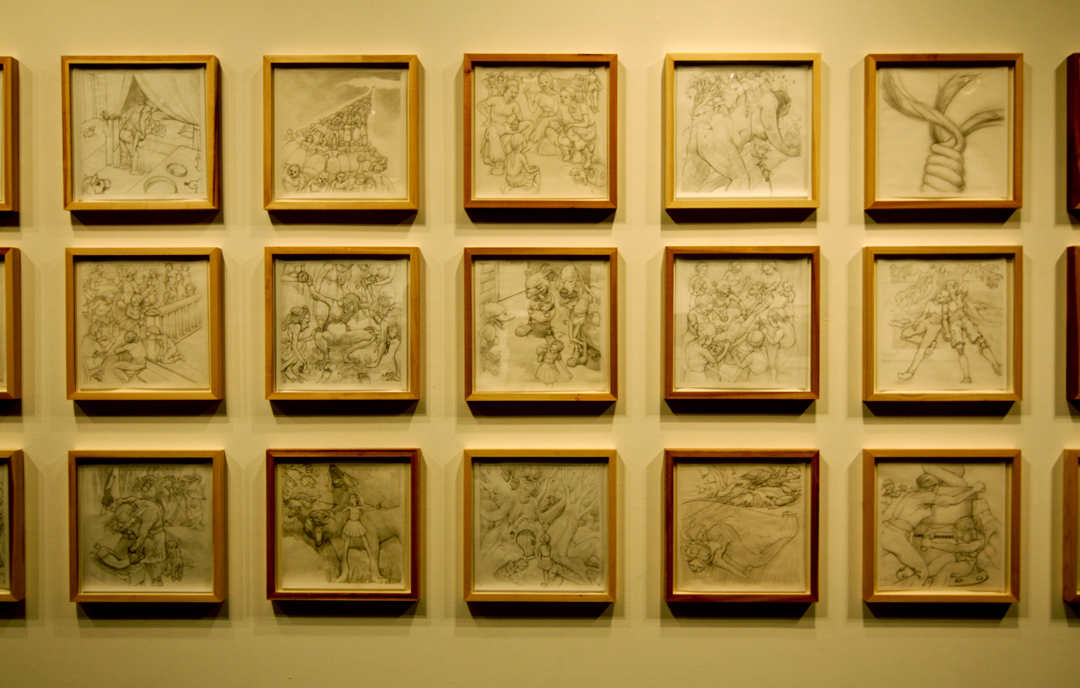
In 2010, I mounted my thesis show, Fables, at MICA. The premise of the thesis is that we humans use the power of stories and mythology to create our world; and more specifically, we use stories to construct gender:
MICA, 15 March 10
 |
| Fables, 2010. Thesis Show |
Most people take their gender for granted, but we are all products of its hand-- perhaps even prior to being born; for as soon as our nascent bodies are perceived by our social network, we are designated specific clothing, room colors, and toys. We are taught how to act, to be, and to think according to the social codes of a specific culture that assigns us our gender. At a young age, we are given specific narratives to absorb as examples of experience, stories and images which have definite impact on our developing intellectual and emotional selves. For young people, this can influence the way we internalize stereotypical ideas of femininity and masculinity, beauty, body image, work, play, and love. For those for whom the gender stereotypes do not fit, the result is varying degrees of gender dysphoria.
 |
| (closeup of first several images on left) |
This body of work is an exploration of the way we visually convey stories. I try to overturn accepted meaning, question assumptions, for the sole purpose of unraveling the mythology of gender as it is currently naturalized. Here, I am plundering the rich and freighted lexicon of stories that we have amassed in the western tradition by identifying the locus of power within the story and inverting it. Gender role switching, acknowledging hidden and unpaid work, making visible marginalized groups, and casting a spotlight on women's difficult choices concerning child-rearing, are a few of the ways in which my work functions to raise awareness of the hazards of being female in our society. In this work I am also exploring a critique of the storytelling genres that have been used for the dissemination of such mythological tales, as these are tightly woven into the ideological underpinnings of folktales and the societies that created them. My experience as an illustrator and predilection for storytelling greatly abets my current ambitions.
Today, as I'm reassessing my trajectory as it is currently placed within the illustration field, I'm finding that I'm on a similar pathway and am continuing to question how gender and other social norms are constructed via our mythologies and stories, particularly within the F+SF genre-- a perfect contemporary platform which speaks to the average person who is immersed in our tech culture. Currently, I'm exploring a tangent concerning technology and how that affects our definition of what it means to be a human, a critical element of my studies during my second and third year at MICA. With this lens, I can explore issues of transhumanism, how we're becoming our technology, and how IT is becoming more like us.
It is my intention to be part of those who are building a worldview that offers an
alternative way of thinking about how one can function as a human in a
society. Changing any aspect of culture requires a shared desire on the part of
the viewer to engage the work in a dialogue that sparks recognition and
identification. A feminist praxis can contribute to the growing disruption of the status quo to create a
window into a future where cultural and social change is imagined,
sought, and inexorable.
 |
| (closeup of several images in middle) |
Sunday, June 30, 2013
Figure Sculpting
In late winter I had the great privilege of taking a sculpture workshop (clay modeling) with none other than world-renowned sculptor, Alex Hromcych, of the Reading/ Philadelphia area. Held in the gorgeous timber-modern studios of Montgomery County Community College in Blue Bell PA, we had a ton of great space to work and work we did.
I missed the first two days of the workshop because of other freelance illustration obligations, but when I finally caught up with them, here is what came of it: The torso (and base) is hollow and the legs are solid. The method by which to obtain this lighter-weight construction is simple, as it requires only that the clay be flattened by pounding it with a paddle into a 1" thick sheet and rolled into a tube. It is then attached to a similarly constructed, flat slab of similar thickness for the base. After that, Alex's only rule was: "Look three minutes; sculpt one."
The piece is about 16" tall and 10" +/-wide on either side.
Mr. Hromcych also demonstrated other sculptural techniques; he constructed a small 18" bas relief and a 12" bust using the same slab-and-cylinder technique.
Our excellent model, David Sanfilippo, works in colleges all over PA and MD, and is a serious expert on Classical poses; with his physique and fitness he's the *ultimate* artist's model. (And he's an all-around helluva guy and a pleasure to work with --he's got great stories and is funny as hell). I have always used drawing or painting media to create figure studies during any figure sessions because it's fast and it's what I'm most comfortable working in. However, I'd definitely recommend to the 2-D artist to take any and every chance offered to sculpt the figure; I learned that it expands and further develops one's sense of the space and volume that a body inhabits.
 |
| Front 3/4 right view |
I missed the first two days of the workshop because of other freelance illustration obligations, but when I finally caught up with them, here is what came of it: The torso (and base) is hollow and the legs are solid. The method by which to obtain this lighter-weight construction is simple, as it requires only that the clay be flattened by pounding it with a paddle into a 1" thick sheet and rolled into a tube. It is then attached to a similarly constructed, flat slab of similar thickness for the base. After that, Alex's only rule was: "Look three minutes; sculpt one."
 |
| Back view |
The piece is about 16" tall and 10" +/-wide on either side.
Mr. Hromcych also demonstrated other sculptural techniques; he constructed a small 18" bas relief and a 12" bust using the same slab-and-cylinder technique.
 |
| Front view |
Wednesday, May 15, 2013
Pricing Your Work
How does an artist price her/ his work? I get this question a lot, specifically pertaining to the market prices for illustration work. If you don't have an agent who knows the ins and outs of what is happening with the market fees for the illustration genre, and you're billing clients on your own, I suggest you get a copy of the most recent Ethical Guide to Pricing by the Graphic Arts Guild. They put out a new volume every year to keep up with the current pricing trends. Even so, you should learn that you can negotiate with clients to bump up the fees once you become more established.
For artists selling their work within any fine art venue (including conferences), the answer is a bit more complex. If you don't live in New York or some other fashionable big city where art is a serious commodity, prices that you can expect for your work will be a lot lower. And prices will be different in the US than in Europe, so be prepared to do a little homework before you put your tag on it. If you're working within a gallery setting, the owner will more than likely be able to offer you some guidance if you need help.
I want to thank collector and art sales guru, Jane Frank, for taking the time to write to me and for her generous advice on the subject of pricing and haggling. (Some of her thoughts on negotiating are loosely transcribed into the latter portion of this entry.)
Artists usually have *some* idea of what they want for a work of art, but let's face it, most artists tend to value the work from a place of sentimentality and that's precisely where there's room for haggling. Sentimental value may be as good a method as any in determining what the market will bear. If the work is of some quality and price is too low, the work will be quickly snatched up. Yet even a low price won't move "poor" quality work*. Where the work is of good quality but priced too high, there exists an opportunity for both parties. "Ugh!" you say; "I hate to have to haggle for my work!" Many artists, indeed, prefer not to discuss it at all, having a rigid take-it-or-leave-it stance. But with the right mindset, you can make a sale where you might not have otherwise, for a price that is still reasonable to both you and the buyer. I was happy to learn that this negotiating process can include fun banter --and no personal insults pertaining to the messy birth of camels on beds. It goes something like this:
Let's say that the art in question is priced at $400.
Buyer: "I don't want to pay your price. Can you do better, or is your price firm?"
Neutral Artist response: "What did you have in mind?"
Motivated Artist: "Make me a fair offer, and it's yours."
Very Motivated Artist: "Make me an offer I can't refuse."
Artist's Banter: If you want more info before committing, add - "Are you really serious about buying?" or "Are you ready to buy now? / Is there some price that would make you buy it now, on the spot?"
Jane says: You can prolong this agony as long as you like, but bear in mind, some buyers hate negotiating, and others love it and will keep you at it all day
Timid Buyer (or one just never wanting to pay retail): "I'm not sure", or "I don't know; whatever you can do." (ie. no offer)
Aggressive Buyer: "How about $250?" (40%)
Very Aggressive Buyer: "How about $200?" (half)
Yikes. What to do next?
Buyer's Banter: The buyer is sidestepping making an offer because then they could see what the artist would do, gauging how much the artist cared about the piece, prolonging the negotiations in the hope of learning more.
Assuming you are not accepting the $250 or $200:
Artist response to Timid Buyer: "I'll go as low as $360." (10%). If he's bought other pieces before, or buying more than one, $340, (15%)
To Aggressive Buyer: "Let's split the difference ($325)."
To Very Aggressive Buyer with whom you don't mind going another round: "Oh dear, that's harsh; you're killing me; wow, I wish I could," etc., etc. "How about $350?"
Jane says, NOTICE: The next natural step up for buyer is $250, and you are back to $325 on the last step, or the 'split' If you do mind going another round, you can call it quits now and "split the difference;" you get $300. Notice that you end up with less by capitulating one round short. An aggressive buyer is counting on the artist to be a 'wimp', and not go all the way for fear of losing the sale.
Jane's Point #1: Remember to never negotiate with yourself. You have no idea what the buyer's best offer would be and you're pricing blindly when you automatically lower your price to what you think the buyer would be willing to pay. Only lower your price after you've wrangled an offer from the other side first, and only to 10%. No more than that: they haven't earned it, or worked for it. You will almost always have a better chance of successfully completing a sale, or come away with more from a sale, if you force a buyer to make an offer. But even at the worst extreme, it gives you the power to either accept, counter, or walk away. While volunteering to lower the price without an offer gets you nowhere, especially when half of the time, the buyer will say "Hmm, ok; I'll think about it."
Jane's Point #2: Don't be intimidated by a slick negotiator who tells you stories about what they paid for other artists' work. Your art is your own unique product and cannot be compared price-wise. Your job is to get the buyer to pay more than he wanted to pay, all the while selling the work for less than you wanted to accept. That indefinable, exact place of pain and pleasure-- less than you thought you would get and more than you thought they would pay-- is where you want to be, every time you negotiate.
Great advice! Thanks again, Ms. Frank! Try out these negotiating tips next time you're at a conference or show, then write to me and let me know how well it worked.
*"Quality" standards for works of art and the subsequent valuation placed upon them are entirely dependent on the buyer / collector / genre and venue. Really.
For artists selling their work within any fine art venue (including conferences), the answer is a bit more complex. If you don't live in New York or some other fashionable big city where art is a serious commodity, prices that you can expect for your work will be a lot lower. And prices will be different in the US than in Europe, so be prepared to do a little homework before you put your tag on it. If you're working within a gallery setting, the owner will more than likely be able to offer you some guidance if you need help.
I want to thank collector and art sales guru, Jane Frank, for taking the time to write to me and for her generous advice on the subject of pricing and haggling. (Some of her thoughts on negotiating are loosely transcribed into the latter portion of this entry.)
Artists usually have *some* idea of what they want for a work of art, but let's face it, most artists tend to value the work from a place of sentimentality and that's precisely where there's room for haggling. Sentimental value may be as good a method as any in determining what the market will bear. If the work is of some quality and price is too low, the work will be quickly snatched up. Yet even a low price won't move "poor" quality work*. Where the work is of good quality but priced too high, there exists an opportunity for both parties. "Ugh!" you say; "I hate to have to haggle for my work!" Many artists, indeed, prefer not to discuss it at all, having a rigid take-it-or-leave-it stance. But with the right mindset, you can make a sale where you might not have otherwise, for a price that is still reasonable to both you and the buyer. I was happy to learn that this negotiating process can include fun banter --and no personal insults pertaining to the messy birth of camels on beds. It goes something like this:
Let's say that the art in question is priced at $400.
Buyer: "I don't want to pay your price. Can you do better, or is your price firm?"
Neutral Artist response: "What did you have in mind?"
Motivated Artist: "Make me a fair offer, and it's yours."
Very Motivated Artist: "Make me an offer I can't refuse."
Artist's Banter: If you want more info before committing, add - "Are you really serious about buying?" or "Are you ready to buy now? / Is there some price that would make you buy it now, on the spot?"
Jane says: You can prolong this agony as long as you like, but bear in mind, some buyers hate negotiating, and others love it and will keep you at it all day
Timid Buyer (or one just never wanting to pay retail): "I'm not sure", or "I don't know; whatever you can do." (ie. no offer)
Aggressive Buyer: "How about $250?" (40%)
Very Aggressive Buyer: "How about $200?" (half)
Yikes. What to do next?
Buyer's Banter: The buyer is sidestepping making an offer because then they could see what the artist would do, gauging how much the artist cared about the piece, prolonging the negotiations in the hope of learning more.
Assuming you are not accepting the $250 or $200:
Artist response to Timid Buyer: "I'll go as low as $360." (10%). If he's bought other pieces before, or buying more than one, $340, (15%)
To Aggressive Buyer: "Let's split the difference ($325)."
To Very Aggressive Buyer with whom you don't mind going another round: "Oh dear, that's harsh; you're killing me; wow, I wish I could," etc., etc. "How about $350?"
Jane says, NOTICE: The next natural step up for buyer is $250, and you are back to $325 on the last step, or the 'split' If you do mind going another round, you can call it quits now and "split the difference;" you get $300. Notice that you end up with less by capitulating one round short. An aggressive buyer is counting on the artist to be a 'wimp', and not go all the way for fear of losing the sale.
Jane's Point #1: Remember to never negotiate with yourself. You have no idea what the buyer's best offer would be and you're pricing blindly when you automatically lower your price to what you think the buyer would be willing to pay. Only lower your price after you've wrangled an offer from the other side first, and only to 10%. No more than that: they haven't earned it, or worked for it. You will almost always have a better chance of successfully completing a sale, or come away with more from a sale, if you force a buyer to make an offer. But even at the worst extreme, it gives you the power to either accept, counter, or walk away. While volunteering to lower the price without an offer gets you nowhere, especially when half of the time, the buyer will say "Hmm, ok; I'll think about it."
Jane's Point #2: Don't be intimidated by a slick negotiator who tells you stories about what they paid for other artists' work. Your art is your own unique product and cannot be compared price-wise. Your job is to get the buyer to pay more than he wanted to pay, all the while selling the work for less than you wanted to accept. That indefinable, exact place of pain and pleasure-- less than you thought you would get and more than you thought they would pay-- is where you want to be, every time you negotiate.
Great advice! Thanks again, Ms. Frank! Try out these negotiating tips next time you're at a conference or show, then write to me and let me know how well it worked.
*"Quality" standards for works of art and the subsequent valuation placed upon them are entirely dependent on the buyer / collector / genre and venue. Really.
The Brand Cage
Several times a year, I put my work in solo or multi-artist shows. It keeps me on my toes as an incentive for generating new work outside of my commissioned illustration work. Almost without fail, somebody asks me how long it took for me to make "X" piece of art. I usually first ask whether they are a student or serious painter, but I can usually already tell. This bean-counter has a certain look about their face. I can see their brain gearing up to crunch the numbers to determine whether the price I have set is in accordance to their preconceived notions about what they think artists should make per hour or per image; it's an amount that is usually stacked against what they themselves make.
My usual response is that it took me 40 years.
In an excellent e-flux article (online art journal) about the political economy of art, contributor, Anton Vidokle, at one point writes about James Abbot McNeil Whistler's libel suit against John Ruskin. Ruskin took Whistler to task in an 1878 review, claiming that Whistler's price for his painting, Nocturne in Black and Gold, was too high a price to ask for a painting that looked so hastily done. Ruskin's argument is that art should be cheap and only reflect the actual time it took to make it. He was suggesting that artists be paid a labor wage for their work based upon an outdated mode of art production, the Guild structure. Asked by the lawyers in the libel suit why he was charging that amount for his painting, Whistler's response was singularly apt: he said that his price reflected the knowledge he had gained over a lifetime of study and practice.
Previous generations of artists who worked as craftsmen within the old European Guild structure relied upon patrons and sponsors to legitimize the work and determine its value. Whistler's libel suit was but one sign of a paradigm shift away from this hierarchical structure under which artists have traditionally labored. Bohemian artists of all kinds, no longer bound to the labor wage construct of the Guild declared a divorce from the bourgeois status quo. Artists began their own collectives and their own shows, and often held down other non-art-related jobs that paid the bills. Freed economically and ideologically from the institution of the salon, too, artists could then begin to experiment with style and content in a way that they couldn't before.
There is a modern counterpart happening in today's illustration field. The huge industry that is Publishing is faltering and shifting hard under the weight of the digital onslaught, and fees for art have gone way down. To compete with dwindling opportunities, some artists have scrambled to "brand" themselves as quickly as they can so that they look professional, as marketable, ready to hawk their product at the most competitive fees possible. With their 30-second elevator pitches memorized, brand-ready students fresh out of art programs are chomping at the bit at a chance to work for a labor wage. Do you think the "brand" as a business model is the milieu for inspiration and creativity? Do Andy Warhol or Jeff Koons spring to mind? Branding just makes it harder for artists to become untied from the corporate art industries upon which they have had to rely for their livelihoods.
However, in the next ten years the Publishing Industry (or what it was traditionally) will be gone, but the recent "branding" strategy that the Market has pushed many artists and small publishing houses into doing will remain. We can observe that the branding spree has created very segregated genres within the illustration field (ie. the very specific look of the children's market), but we can observe this very same phenomenon within the fine art markets too. I can't tell you how often I have gone to a conference or show only to think that I've seen all of the work before. The markets have their own "look" to them, and artists think that they must tailor their work to fit the market trends and not the other way around. Sadly, this is indeed, the case when it comes to these institutions: conform or be cast out. We have abandoned the bohemian mode in favor of professionalism, marketability, easy categorization, and consumability.
This branding is troubling. Once there in that pigeonhole, if you want to stretch your wings, there's no way out except via a major overhaul. Imagine having a brilliant insight into your work that dramatically changes your style or content overnight. Then what? Do you take five years to gradually shift your work so that it better reflects your ideas? The markets's tight genre structure means that you will still lose those clients/ buyers whether you do it quickly or over a period of time.
Refraining from branding just means that your cage isn't as tight. Perhaps it's time to ask whether the structure itself is at all conducive to real creativity.
My usual response is that it took me 40 years.
In an excellent e-flux article (online art journal) about the political economy of art, contributor, Anton Vidokle, at one point writes about James Abbot McNeil Whistler's libel suit against John Ruskin. Ruskin took Whistler to task in an 1878 review, claiming that Whistler's price for his painting, Nocturne in Black and Gold, was too high a price to ask for a painting that looked so hastily done. Ruskin's argument is that art should be cheap and only reflect the actual time it took to make it. He was suggesting that artists be paid a labor wage for their work based upon an outdated mode of art production, the Guild structure. Asked by the lawyers in the libel suit why he was charging that amount for his painting, Whistler's response was singularly apt: he said that his price reflected the knowledge he had gained over a lifetime of study and practice.
Previous generations of artists who worked as craftsmen within the old European Guild structure relied upon patrons and sponsors to legitimize the work and determine its value. Whistler's libel suit was but one sign of a paradigm shift away from this hierarchical structure under which artists have traditionally labored. Bohemian artists of all kinds, no longer bound to the labor wage construct of the Guild declared a divorce from the bourgeois status quo. Artists began their own collectives and their own shows, and often held down other non-art-related jobs that paid the bills. Freed economically and ideologically from the institution of the salon, too, artists could then begin to experiment with style and content in a way that they couldn't before.
There is a modern counterpart happening in today's illustration field. The huge industry that is Publishing is faltering and shifting hard under the weight of the digital onslaught, and fees for art have gone way down. To compete with dwindling opportunities, some artists have scrambled to "brand" themselves as quickly as they can so that they look professional, as marketable, ready to hawk their product at the most competitive fees possible. With their 30-second elevator pitches memorized, brand-ready students fresh out of art programs are chomping at the bit at a chance to work for a labor wage. Do you think the "brand" as a business model is the milieu for inspiration and creativity? Do Andy Warhol or Jeff Koons spring to mind? Branding just makes it harder for artists to become untied from the corporate art industries upon which they have had to rely for their livelihoods.
However, in the next ten years the Publishing Industry (or what it was traditionally) will be gone, but the recent "branding" strategy that the Market has pushed many artists and small publishing houses into doing will remain. We can observe that the branding spree has created very segregated genres within the illustration field (ie. the very specific look of the children's market), but we can observe this very same phenomenon within the fine art markets too. I can't tell you how often I have gone to a conference or show only to think that I've seen all of the work before. The markets have their own "look" to them, and artists think that they must tailor their work to fit the market trends and not the other way around. Sadly, this is indeed, the case when it comes to these institutions: conform or be cast out. We have abandoned the bohemian mode in favor of professionalism, marketability, easy categorization, and consumability.
This branding is troubling. Once there in that pigeonhole, if you want to stretch your wings, there's no way out except via a major overhaul. Imagine having a brilliant insight into your work that dramatically changes your style or content overnight. Then what? Do you take five years to gradually shift your work so that it better reflects your ideas? The markets's tight genre structure means that you will still lose those clients/ buyers whether you do it quickly or over a period of time.
Refraining from branding just means that your cage isn't as tight. Perhaps it's time to ask whether the structure itself is at all conducive to real creativity.
Wednesday, February 20, 2013
So You Want to Be an Artist, eh?
I'm often asked to look at the work of a high school student and to assess whether they have "the stuff" to make a go of it in the art world. I figure that if s/he has asked, then s/he really wants to know the truth, but most don't really like hearing it. I try to keep the news as positive as I can, weighing both pros and cons, but it isn't all pretty.
The "Bad" News
Degrees in Visual and performing Arts comprise 6 percent of students in any college's graduating class, but only two percent of that number actually *do* art after college. And most artists who begin as artists don't persist as artists. They give up after about 3 years... or do it only sporadically.
Many, if not most, artists who are "professional" artists have day jobs-- teaching, working in print shops, working as a layout designer, etc.-- that bring home the bacon, but don't always offer an artist the time to make their own work. (Women artists are most often "ghettoized" in the children's illustration market, which is regrettably low-paying and requires fast turn-around for completions. That said, if you can break into a more competitive genre-- editorial, or F+SF, gaming or film animation -- you have a better chance of making more money. That is, if you don't have children --or if you do, you need an awesome spouse, a nanny, a maid, and a cook.)
So, art is like a calling to the monastery: don't do it unless there's nothing else that will *quite do*, because the obstacles are Sisyphean. Your own self-doubt will provide to be one the biggest boulders to roll uphill. Count on it taking about 5 years after college/ school to break into a very competitive industry and to begin to gain some sort of industry recognition.
So do you have the "stuff" to make it? Here are some Illustration specifics that one has to be able to handle pretty well: being self-employed means meeting deadlines on time, working alone, keeping distractions and interruptions at bay, being diligent with your work hours, keeping receipts for taxes, paying for advertising and self-promotion, paying for one's health insurance and planning for "retirement" (whatever that means), budgeting for lean times, paying quarterly self-employed taxes, being able to communicate well and deal amicably with art direction (even when it occasionally goes against your aesthetics or sensibilities). The uber-social person may find it to be lonely; the uber-anti-social person with few people skills may find him/herself at a disadvantage.
The industry has withstood big changes in the last 20+ years, most of which can be seen in the current digital age of e-Books and self-publishing. Companies have severely limited the scope and hire of artists for their publications. It means that those book covers you have had your eye on doing, twenty years ago used to pay an artist $2000; they now pay $750 -- or in the case of romance novels, $75. Illustration fees have not only remained the same in a generation, they've actually decreased. Digital media has had much impact on the art in the industry.
So why the heck would anyone want to be an artist anyway? Oh, I know: to express yourself, right? Let's be serious; you can do that with a video-camera, or a blog, or a FB page. Being an artist as a profession or occupation requires a dedication that goes beyond merely expressing oneself. It's a mission that goes deeper that just having an interchangeable day-job that you can shrug off; it requires years of practice to build the necessary skills, and demands constant vigilance and navigation.
Don't pay any attention to the occasional story of the rock-star, overnight-success artist. This kind of rare story only fuels the Myth of the Artist and creates unrealistic expectations for would-be creatives. It creates a false expectation of freedom, glamour, fame, and fortune that is just nowhere near the reality for the day-to day artist which is just a lot of work. Sometimes more work than is fair and less pay than is fair, but that's the way it is. Most artists, even if they are self-employed full-time, live quiet and unassuming lives as conscientious workhorses. The odds of being made The Big Shit are pretty low.
Hey you... Are you still here, muttering foul curses at me under your breath and vowing to achieve your dream despite my splash of ice water? Well then, you are either a glutton for punishment or a damn fool. Welcome to the club.
Some "Good" News
As an artist, you are the creator, the generator of new ideas. Whether you're in the publishing industry as an illustrator or as a writer, or working as a fine artist to sell work directly to clients, or whether you're a basket maker or potter, or sculptor, YOU are the one generating new content-- you have a voice in shaping your culture. Therefore, it is *possible* to have complete creative control over what you make if its content/ story is yours. (this is harder in the illustration industry where it's often someone else's story /content). See Tony DiTerlizzi's Spiderwick Chronicles for a fine example of an artist writing and illustrating his/ her own story.
What this also means is that you have the ability to create your own income with original work and content you generate. It means that it's also possible to set your own hours and schedule as well. This self-directed-ness is a really nice feature of being self-employed.
What about the fine art industry? While there has been a sideline business in the illustration convention industry to entice fine art buyers and dealers to purchase original finely-crafted works, many artists who have an illustrative style, have sought to sell their work within fine art venues only. (However, when repped by a gallery, complete artistic control over one's work isn't always possible if the gallery owner has contractual say about the content and style that the artist is producing. They can and will often dictate that you continue to produce the kind of work that sold well in the past. They have specific clients looking to buy art with that particular "look" so experimenting with changing your style or content to keep your practice sustainable and happy for you can be a bad thing for them. This goes double for the illustration industry, and or agents who might represent an artist to their clients. if you suddenly change your style or content, you will shift your market and lose your client base. Okay, so that was more bad news.) The good news is that even if you lose some clients by changing or updating your style/ content, you can gain clients elsewhere. That's the nature of freelancing: you can work for whomever you want.
Additionally, most importantly-- you get to be a lifelong student of the world. All of your interests can be dovetailed into your art and can help generate relevant work. This is what it means to find your "voice". I would recommend that if you are still unshaken in your desire to be an artist, then get exposed to as many subjects as you can-- history, philosophy, feminist studies, biology-- and be able to see what all of the world offers and that ideas and art are interconnected. One cannot make art in a cultural vacuum. So much to consider, right?
Subscribe to:
Posts (Atom)