Showing posts with label art theory. Show all posts

Friday, December 15, 2017

What are You Resisting?


The US's political climate today is fraught with all kinds of contested space. Many of us who are not economically in the top 1%, white, male, or cisgendered, may find ourselves fighting against policies intended to benefit anyone but us. As a result, many political activists have joined together to form "The Resistance" to stem the tide of what seems to be a politcal effort to regress back into the social policies of the 1950s. Many are fighting for basic necessities such as clean water (Flint, MI), healthcare, and equal rights like marriage or voting.

And some are fighting *against* the plutocracy's outrageous and evil notions-- such as the efforts to reduce the land in National Parks, drilling in the pristine Arctic, destroying sacred Indian ancestral burial lands, or to kill net neutrality.  Despite some progressives' lamentations that one can't just be "against" the conservative agenda, but that we must be "for" something, resistance is absolutely critical in this era so that we don't just slip into fascism. 

The Trout Gallery
Sue Coe, You Consume Their Terror, 2011.
The question of "what are you resisting?" is a good one to ask when discussing political or social forces over which one needs to have a strategy. But it's also a good question for the artist to ask "what am I resisting within my practice? Is there something that I'm avoiding thinking about or doing?"

Are you resisting tackling a specific thing in your practice? What are the reasons? Are they valid reasons? Is your resistance a matter of not acquiring a skill set, or is it a resistance to navigating daunting logistics like money/ space/ or time?  Do you not enjoy a particular kind of subject matter because you have some kind of philosophical bias or emotional barrier to overcome to get there? 

My grad school mentors did a good job of breaking down our resistance to subject matter or physically challenging constraints like size or complexity. Inertia / laziness can be a mighty obstacle for some, but nothing can replace "ass in the seat time" for gaining important experience within one's practice. My own resistance against depicting babies or children, working large, and working without color, was broken down gradually so that I'm now able to ask myself whenever I feel like I'm dragging my feet about doing a particular thing, "against what and why am I being so stubborn?" From there I can analyze whether there are logistical problems for which I need to find a workable solution, lack of a particular skill set that needs to be acquired, or whether I'm experiencing some kind of bias in my thinking. And then I need to decide whether overcoming that obstacle is in the best interest of my sustained practice. (Usually the answer is yes).

Resistance to destructive social and political policies also provide the opportunity to make great art.

So what are you resisting?


Sunday, August 25, 2013

Potboilers

Your best work will not be produced via commission. Your best work will come from your own vision, undiluted by anyone else's input, and achieved from long uninterrupted hours at your easel. That said, we illustrators thrive on the crazy adrenaline rush of assignments that come at us in a flurry and fly out of our studios just as quickly, leaving us wild-eyed and tired with some money in our pockets. The commissioned project can give us a sense of accomplishment and pride but cannot in the long run sustain us or boost us to the next level of individual skill or personal idea formulation. Assuming that you desire a fulfilling art career in which you get to lavish your attention and manual skills on ideas and projects that you love, then you may want to rethink what projects you take on.

A career made of fast, short projects or uninspiring commissioned work will *never* allow an artist to really hone any rigorous painting or drawing skills other than perhaps how to cut corners for speed. Duh, right? Fast short projects can occasionally be a good exercise for making the illustrator to have to think quickly, sometimes producing clever results. However, this too can eventually go awry since those initially clever solutions can become gimmicky or produce cookie-cutter responses. We see this happening in a lot of the F+SF industry; when artists are asked to design, rough out, and execute a project in color within a few days, many of the solutions become formulaic. Much of the children's science and educational industry is geared towards this kind of production as well. Schedules are often so tight that artists adopt "styles" from whatever is trending in any given season. Fine artists, too, occasionally take on uninspiring commissions for quick income and do so to their own detriment when they allow the patron to dictate the outcome.

Young illustrators looking for quick entry into the industry, the promise of "getting one's feet wet", "exposure", or the feeling of "paying your dues" are always tempted by potboilers. Female illustrators are even more susceptible to falling into the potboiler trap and never getting out. The social reality of women's lives is that mothers' and caretakers' time doesn't often include long uninterrupted hours for big projects; small assignments can be completed in very short bursts and can tolerate incessant interruptions. In an industry like F+SF where rigorous painting and drawing skills are more valued and monetized, the potboiler trap may be greatly implicated as to why there are fewer women illustrators in this genre.

Almost all artists see potboilers as a pathway to "bigger and better things." What is this "bigger and better" thing? And can't we just skip right to it?

Potboilers don't pay all that well so the bar for quality is set a bit lower; the company isn't taking any real economic risks with these works. Depending on how fast you work, you may be able to crank out a dozen or more of these in a month's time in order to pay the bills. Month after month and year after year you may have your bills paid, but will you really satisfied with a career built on throwaway commissions? If you're not spending an equal amount of time on your own personal projects, then your *career* is eroding your artistic desire and you will eventually lose your artistic integrity.

I will say it again: short, fast, throwaway projects will *never* bump you up to the level of the "big players." Why? Because quick and dirty commissioned work is not the same thing as honing your skills or developing a sustained lifetime practice in art. Ask yourself: why did you get into this in the first place?

Better commissions pay more, have lengthier turnaround time, and offer the artist more say in the conceptual process. By paying the artist more, the company is taking more risk and investing in the artists' vision.These are rare commissions and seasoned illustrators are more likely to secure them. If you aren't able to get these commissions right now because you need to build up your "artistic vision capital" within the industry, then the bigger and better thing is having your own "fine art", personal work to do. It is better to spend your time working on your own ideas. stories, and developing a rigorous practice than to waste your time and effort on crappy commission work.

It is the luxury of time spent on a project that an artist needs most of all. Time to conceptualize an idea and plan out a series of images that best carry that idea. Time to grex and mull over the drawings and make revisions if necessary. Time to plan the color and value structure. Time to luxuriate in the medium. It is quality studio time only that will produce excellence in the artist.

Saturday, July 20, 2013

The Chameleon

You're traveling with a fairly new friend in an unknown part of the country, through backwoods and small towns, and you stop for gas. It's the first time you've spent any extended period of time with this friend outside of the city for any reason and it is going pretty well.

350 miles later, you pull into a small station for a stretch break and fuel, and you head to the loo. When you return, you find that while you were gone she has been engaged in an extended conversation with the station owner who has pumped the gas and wiped the windshield. The weird thing, see, is that all of a sudden she has a thick country drawl that you've never heard before.

Ok, so maybe you admire the Chameleon's ability to "manipulate" people like this.  Perhaps you approve of the fact that they know how to "blend in" and make others comfortable by being like them. Perhaps you even ARE one of these chameleons.

The problem with the talented Mr. Ripley's strategy, apart from the fact that she cultivates a separate personality for each person she encounters, is that you don't really know the real person either because she has a "facet" for you too. You're just one more person in her conception of a particular "people model" that she emulates.

The bigger problem is that she may not even know who she is.

Unfortunately, this social chameleon model seems to have a counterpart in the art world: it is the artist who bends and flexes with what she thinks the industry wants. There are those who will say, "But, wait! The artist needs to acknowledge and fit into what the industry is doing! The artist must bend to the desires of the audience or they will never sell / be hired for anything!"

Is this true, or is it pandering? And is it even possible to be sui generis in an age whereby digital images of everyone's work constantly bombards us from all corners of social media?

The aspiring artist wants to be the greatest thing to hit the genre, and in her effort will latch on to what she thinks is the hottest trend that the industry is currently hawking. (Mermaids, anyone?) She will try to reproduce what her favorite artist(s) is doing and so becomes a copy-cat. However, the industry is rife with copycats, all trying on the "new thing," but, in the end they all end up, ironically, losing whatever uniqueness that may have allowed their work to stand out in the first place.  The work becomes just an echo of someone else's.

Start out by doing something different. Challenge the industry with your conceptions of what it -- and the world-- should look like.

Finally "Making It"

Those of us who enter any field of the arts recognize the phrase "making it." This is usually centered around the idea that once you gain a certain momentum in your work, that you've "made it." In the illustration field, it's about "breaking in," which means getting freelance work in the publishing industry.

For most aspiring artists, it's about being able to quit the boring day job and working full time at one's art. Others put a price tag on the achievement; making X dollars per year is the goal. For some it's all about recognition from one's peers and winning certain industry accolades. How do you define it?

I had a revelation recently that defines it yet another way. What if "making it" has nothing at all with the industry? What if it's purely about one's own satisfaction? What if it's only about the doing?

My own trajectory of "breaking into the field" long ago included a speedy 3-day transition from my day job as a house cleaner when I promptly got 2 books upon submitting my work to publishers (my first of many self promotional forays). Working in the children's science and educational market under the auspices of a well-known NYC agent, I began to define "making it" as not just being able pay my regular bills, but to have a "comfortable" life, ie. economic padding beyond an emergency fund.  After a decade of trying to get ahead, I became unhappy with my meager income, so I worked even harder; I hustled taking on more and more projects, really anything my agent set me (minus work from overtly religious institutions). I worked smarter, streamlining my technical skills even more, shortening the amount of seat time with time-saving strategies in design and facture.

Still, it wasn't enough.

I began to see that much of my frustration was borne of boredom with the science market. After 1000 or so paintings of Monarch butterflies, 1000s of paintings of the same big African Safari / Arctic/ Jungle fauna, 100s of images of the same species of flower under one's belt, one finds that one has painted them in every permutation possible --and then one begins to question the sanity of an industry that only uses certain commodifiable species over and over to generate its consumer base. It became imperative for me to get out.

According to my standards, I was no longer "making it" and this played havoc with my self-esteem. I felt like I was a failure. But at what? I was voluntarily leaving behind 20 years of clients and a solid reputation, but decided to strike out and try to "break into" another part of the illustration industry.

So, starting over....

Three years later, after having transitioned into to the F+SF genre, I am happier with my subject matter;  I am rejuvenated spiritually and my illustration practice is sustainable again. Teaching part-time at a local college, too, provides me with an important academic outlet that was missing. The additional income as an adjunct prof relieves the pressure on having to sell my soul; I can be choosy about what projects I accept as a freelancer. The bigger struggle, however, has been to redefine what it means for me to be "making it." No longer can I tie it to money or being completely self-employed, because teaching is something that I truly love and now wouldn't want to give that up. Neither can I tie it to recognition because I've walked away from those clients who used to ask for me by name. For me, real success-- making it-- has become the freedom to pick and choose the projects that I want to do. It means having the time to produce my own self-generated work in which my voice and my ideas are clearly represented.

How freeing.

Not surprisingly, "making it" has nothing to do with money, industry recognition, etc. It never has. It has to do with making the work. Yes, that's right. Every day that you get up and do your work is making it. When you come home from your day job, shut the door to your studio and get to work, that is making it.  When you produce something that you love, that is making it.

When it comes down to what you really get from art, you will find that there is no other substitute.

Wednesday, May 15, 2013

The Brand Cage

Several times a year, I put my work in solo or multi-artist shows. It keeps me on my toes as an incentive for generating new work outside of my commissioned illustration work.  Almost without fail, somebody asks me how long it took for me to make "X" piece of art. I usually first ask whether they are a student or serious painter, but I can usually already tell. This bean-counter has a certain look about their face.  I can see their  brain gearing up to crunch the numbers to determine whether the price I have set is in accordance to their preconceived notions about what they think artists should make per hour or per image; it's an amount that is usually stacked against what they themselves make.

My usual response is that it took me 40 years.

In an excellent e-flux article (online art journal) about the political economy of art, contributor, Anton Vidokle, at one point writes about James Abbot McNeil Whistler's libel suit against John Ruskin. Ruskin took Whistler to task in an 1878 review, claiming that Whistler's price for his painting, Nocturne in Black and Gold, was too high a price to ask for a painting that looked so hastily done. Ruskin's argument is that art should be cheap and only reflect the actual time it took to make it. He was suggesting that artists be paid a labor wage for their work based upon an outdated mode of art production, the Guild structure. Asked by the lawyers in the libel suit why he was charging that amount for his painting, Whistler's response was singularly apt: he said that his price reflected the knowledge he had gained over a lifetime of study and practice.

Previous generations of artists who worked as craftsmen within the old European Guild structure relied upon patrons and sponsors to legitimize the work and determine its value. Whistler's libel suit was but one sign of a  paradigm shift away from this hierarchical structure under which artists have traditionally labored.  Bohemian artists of all kinds, no longer bound to the labor wage construct of the Guild declared a divorce from the bourgeois status quo. Artists began their own collectives and their own shows, and often held down other non-art-related jobs that paid the bills. Freed economically and ideologically from the institution of the salon, too, artists could then begin to experiment with style and content in a way that they couldn't before.

There is a modern counterpart happening in today's illustration field. The huge industry that is Publishing is faltering and shifting hard under the weight of the digital onslaught, and fees for art have gone way down.  To compete with dwindling opportunities, some artists have scrambled to "brand" themselves as quickly as they can so that they look professional, as marketable, ready to hawk their product at the most competitive fees possible. With their 30-second elevator pitches memorized, brand-ready students fresh out of art programs are chomping at the bit at a chance to work for a labor wage.  Do you think the "brand" as a business model is the milieu for inspiration and creativity? Do Andy Warhol or Jeff Koons spring to mind? Branding just makes it harder for artists to become untied from the corporate art industries upon which they have had to rely for their livelihoods.

However, in the next ten years the Publishing Industry (or what it was traditionally) will be gone, but the recent "branding" strategy that the Market has pushed many artists and small publishing houses into doing will remain. We can observe that the branding spree has created very segregated genres within the illustration field (ie. the very specific look of the children's market), but we can observe this very same phenomenon within the fine art markets too. I can't tell you how often I have gone to a conference or show only to think that I've seen all of the work before. The markets have their own "look" to them, and artists think that they must tailor their work to fit the market trends and not the other way around. Sadly, this is indeed, the case when it comes to these institutions: conform or be cast out. We have abandoned the bohemian mode in favor of professionalism, marketability, easy categorization, and consumability.

This branding is troubling. Once there in that pigeonhole, if you want to stretch your wings, there's no way out except via a major overhaul. Imagine having a brilliant insight into your work that dramatically changes your style or content overnight. Then what? Do you take five years to gradually shift your work so that it better reflects your ideas? The markets's tight genre structure means that you will still lose those clients/ buyers whether you do it quickly or over a period of time.

Refraining from branding just means that your cage isn't as tight. Perhaps it's time to ask whether the structure itself is at all conducive to real creativity.

Nothing New Under The Sun


We've all heard it before: You must be Unique! You must be Original! If someone doesn't actually say it to our face that we're not being unique or original, we still feel the admonishment internally. Some are more blunt: I showed some recent work to some students and one slyly asked whether I was worried that what I was doing wasn't completely "unique." It's what's drilled into our artists's brains: If we can't be totally unique and original, then we're slackers, failures.

Well, I've got news for you. There are no new ideas. Really. Images can't be created that have no other contextual source. Just try doing it. What we as humans visually ingest on this planet, and can dream about, has been filtered through a brain and a consciousness that has a common DNA structure and origin. However, what can be quite new are innovative juxtapositions and connections that hadn't been made before.

You may be decried as a plagiarist if you copy someone else's style directly, but this is only something to worry about if you're selling your work "professionally" as an illustrator or fine artist.  Stealing from one artist may be considered plagiarism; however, stealing from many is considered art. This method of synthesizing influences is what makes a style unique. Therefore, a student should feel free to copy, copy, and then copy some more. Take everything that inspires you and run with it. Your style will be generated where your ambitions collide with your skill level and this changes and shifts over a lifetime. So many young artists fret about "not yet having a style." You should worry more about not having any ideas.

But what about the "professional" artist?  You have probably already seen these two images together: Michelangelo's Prophet Isaiah from the Sistine Chapel ceiling (1508-1512), and Norman Rockwell's Rosie the Riveter (May 1943 issue) for The Saturday Evening Post:
Dude looks like a lady...


Make me a sandwich...?

So what did Rockwell actually "steal?" The pose, and fairly directly. However, Rockwell improved upon Isaiah's posture (see the tilted shoulders? the defiant chin?) and added believability and a solidity to Rosie's anatomy that wasn't there in the "flattened" medium of the fresco. Rockwell's Rosie has the same nobility and stature as the saint, but casting the figure into this modern context changes everything. Rockwell has completely stolen it and made it his own. It is Rockwell's idea that transforms it.

So does an artist ever stop "stealing" from other artists? Not really. If you want to continue to grow and make your practice sustainable, you will need to keep experimenting with new styles, foreign designs, and taking risks with new ways of thinking. So don't just borrow and skim ideas. You will really need to try them on and perhaps buy them. And then don't be afraid to break them.

Hey, just so you know, I was partially inspired to write this blog entry from the writer and artist, Austin Kleon. Buy his amazing book, Steal Like An Artist and get inspired.  (:


Tuesday, April 30, 2013

Intensity's Overflow

A good friend of mine asked me to comment on the following quote:

Imagination and artistic passion must stem or at least be easier to retrieve from our subconscious mind. The subconscious mind contains the runoff of emotions that are so passionate that although our brain produces them, they are inappropriate to express within normal social limitations. Perhaps the brains of true creative geniuses produce more emotions than most individuals or they merely suppress more emotions. However these so called geniuses definitely do have the gift of expressing these emotions. --"Creativity, the Subconscious, and Daydreaming" by Melissa Hoba 

I've often thought about why some people are driven to art. And I've thought about why art has permeated the culture like it has since the dawn of humankind. There's something about it that just can't be ignored or expunged. Artists will make art whether they make a living from it or not. Funny that the media can change (digital/ high tech) and the definition of art can change (ranging from traditional, modern, contemporary, to allographic), but the way in which it functions within the human psyche is still the same.

Yes, CREATIVITY: poetry, visual art, music, dance, are definitely a "spilling over" of the emotional experience-- it's the avenue for us to express that for which we have no words.  Our human experience is unique for each individual, yet, there's something similar in the way we function as humans that allows us to use art as a medium to reach any other person(s) as our audience. I think, for some, art may be sought and valued in the same way others might seek a religious or experience. Some would say that that experience (whatever that may be) is our connection to the sublime and allows us to contemplate our existence as something which has more value than just material consequence. Art imparts meaning, an inter-connection with others, and deepens our definition of what it means to live as a human.  It's quite a unique thing.

Additionally, I think every human being possesses the capability to create art and to be creative, so in the above quote, the word "genius" bothers me. Since art is the spilling over of similar emotions that we humans mainly seem to share, it is possible to for everyone to express themselves-- especially in this day and age where leisure time for such pursuits is more common. However, as it is with all things human, because some feel more intensely than others, some will be driven more than others to make art, so not all humans will make art. All can, however, think creatively, or be encouraged to do so, and it can be taught. 

Art also gives us a space to express taboo subjects. It's a perfect way to live vicariously through the characters which "speak" within a story.  This "make believe" place has been-- and remains-- the one place by which people can express that which oppresses them when they have no other psychic outlet. It's a safety release valve for society-- people can see themselves "doing" and "being" that which is currently impossible. It's a way to dream the future into being. It's a way to seek redress for injustice where no justice currently exists.  In other words, if your life experience is full of pain and anger based upon real social or personal injustice, your art is a way to create another virtual reality in which you can escape to live within a facsimile of normalcy. This other function of art that allows us to imagine other realities makes me wonder if the current rash of violence in our world could be channeled and defused if art as a serious subject was again available in all schools. Just a thought. (Of course, not all artists use their art to release negative emotions-- some use it to express joy and love, curiosity and fascination about the world, etc.)

As an educator, teaching students how to think creatively is my main pursuit. The strategies of drawing include far more than just the way paint and color functions, or how line and mark is applied; there's an entire philosophy of Being to take into consideration. We can encourage our students to think about their own unique stories and draw upon them for inspiration. We can encourage them to think beyond the literal image-- to pull from their subconscious-- that mark, that gesture, that symbol, that color, which imparts meaning to the image beyond merely recording. The sharing of our experiences and emotions through Art is the glue that holds society together-- it's a tenuous prospect....

Thursday, January 24, 2013

Justice To Judith

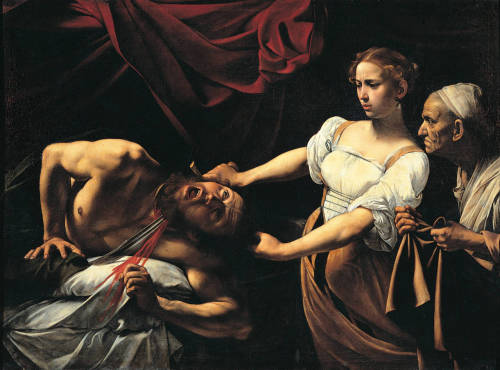
The first painting, Judith Beheading Holophernes, was completed  by Caravaggio in 1598. The execution is flawless and the composition is appealing despite the relative calmness of it all.

(Oh, snap, someone is beheading me...)

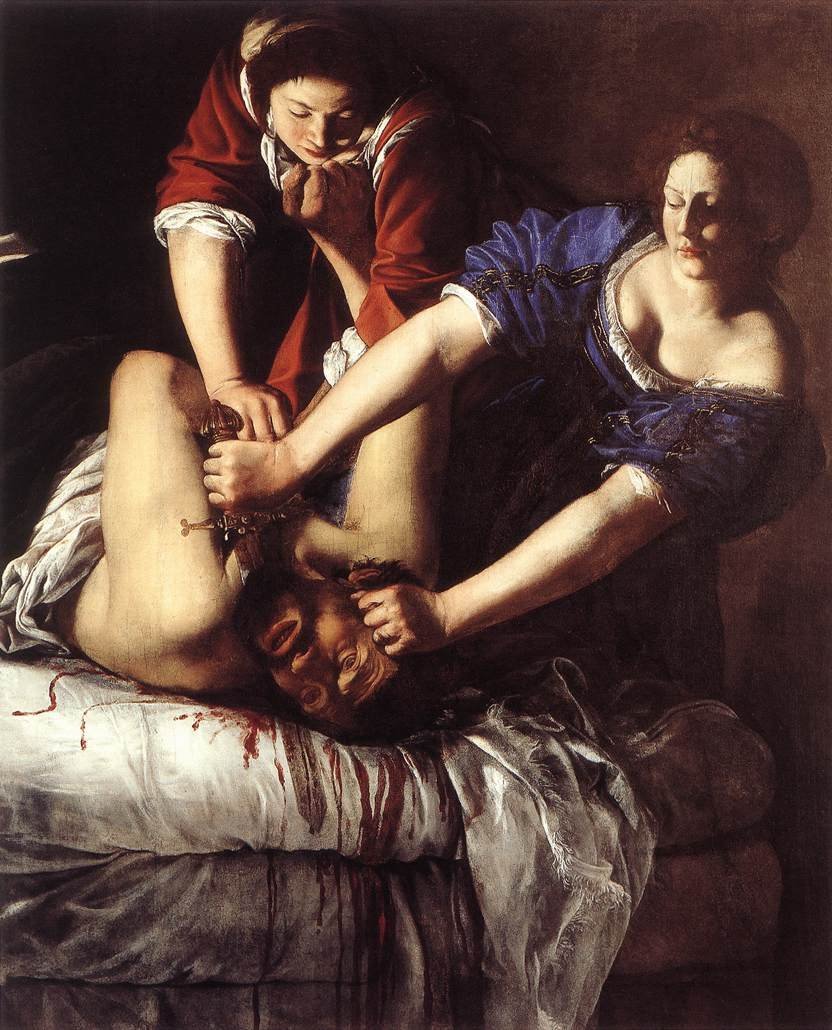
The second painting, Judith Slaying Holophernes, 1611, was done by a woman painter of the same era, Artemisia Gentileschi, who must have seen Caravaggio's and decided she could perhaps add something to the story.

Gentileschi's re-interpretation of the story has improved it greatly and kicked the former's two-dimensional keyster.

The Judith in Caravaggio's piece seems to be quite squeamish: she is intent on leaning as far away as she can to avoid bloodstaining her dress. The poor dear's worried look on her brow seems to convey that she's uneasy about having to do this despite the fact that General Holophernes and his Assyrian army have come to destroy her city and home. The maid behind her has an appropriately disgusted look on her face but is still  only passively waiting to receive Holophernes' noggin.  Picking it apart further, the spurting blood looks caricatured, as if  ridiculous strings of yarn were attached to the model while he was posing for the artist.What begins to dawn on the viewer is the possibility that the painting was conceived from the vantage point of Holophernes-- as if the story was all about him and his fleeting pain.

Gentileschi's Judith becomes much more capable; this is the story about Judith.
Take note: This is how you do it.

Notice that the composition is much more dynamic and the postures of all characters much more believable. This is a powerfully competent widowed queen (look at those arms!) who is used to taking care of business and she has chosen her staff to support her in whatever needs to be done. The maid has jumped in to help restrain him because there is going to be a struggle (why wouldn't there be??) and they are not going to be deterred, dammit. Even the blood looks more believable. 

It is important for an artist to build into the composition the postures and expressions that best exemplify the characters and their story. We're not always given all of the details of the story, so we must extrapolate the information. What would the character really have endured? What might have been going through her/his head? How might s/he truly and realistically behaved? Putting oneself into the shoes of the character based on one's own experience might be what's needed.   

Friday, December 14, 2012

More Fighting

Ah, but I have good news for ye.

Knowing where you land philosophically in the skirmish between Romanticism and Contemporary Art can help you determine the kind of work you want to make. If you're asking yourself, "What should I paint? Should I paint a boat?" then this might be good information for you.

Think of Art as a kind of box. The center of the box is circled "Traditional Values." This would include the most assiduous practitioners of Romantic era painting and its ideological themes (think: Wm. Adolphe Bougereau). The outer edges of the box contain the fringiest and wackiest elements of contemporary art (Schneeman's interior scroll performance?). These folks on the margins even raise eyebrows among the mainstream Contemporary set.  You are probably somewhere in the middle ring, floating at times toward the traditional, other times out to the margins. That's to be expected especially if you're a student, but some floating should be something to strive for as a professional too.

What happens when you don't fit either of these categories??
What if you're not a contemporary artist per se, with all of the edginess appurtenant to that label, but you can't see immersing yourself in fantasy wholeheartedly? Perhaps the idea of the sentimentality of the genre really turns you off.

Well, there is a third place to be....


A Fight For Reality

Mention the Romantic era painter, Bougereau, to a contemporary artist and he will make a face as if he's been forced to sniff a pile of cat poop. Try to discuss the merits of Sol LeWitt's work to a traditional painter and he will likely flip you the bird. Ever wonder about this antagonism? It's a case of sibling rivalry.

For now, I'm going to conflate Modernism with Post-modernism and the Contemporary art era for simplicity's sake-- mainly because most people tend to lump them together even though they are formally separate art periods. The Modern era of painting, as we learn in every Art History 101 class, was mainly a response to the sweeping changes brought by Industrialization. Artists and writers (as well as many other folks) were really disturbed by what they perceived as the impersonalization of mechanized life.While artists had borne witness to political and social issues in the past, this particular upheaval was so encompassing it drove the artistic output of great numbers of creatives. Many artists began to question traditional academic standards, embrace new materials (paints in tubes and the camera), and experiment with new techniques. The mid-1800s marks two artistic movements: the Romantic era and the beginning of the Modern era. Let the cat fight begin.

The Romantic movement was not just a backlash to the rise of the industrial complex, but a rejection of the Enlightenment era's rationalization of nature and man. The modern world threatened to become something monstrous and people looked for ways to escape from it. Disgusted with the smog and soot of the cities, artists painted works that emphasized the beauty and wonder of nature, while adventurers immersed themselves in it physically. Writers and philosophers elevated emotion and intuition as "natural" sources of "authentic" information. Belief in the supernatural enjoyed a resurgence in the form of galvanism, and occultism was popular. (Mary Shelley's Frankenstein is a perfect example of the fear that the innovations of science would change our basic human nature.) Politicians embraced traditional values and found that folk tales reflected this ideology, and an interest in the practices and beliefs of the medieval period and European historical ancestry sparked elements of nationalism.  This escape into the fantasy world away from modern fears marks the beginning of the Fantastic/ Fantasy genre in literature and art.

During the same period, the Modern era of art and literature was beginning. Artists' initial response to the industrial world was to turn a level gaze toward modernity and criticize its injustices and ugliness. Embracing new materials, ideas, and techniques (ie. photography), Modernists experimented and dispensed with traditional ways of painting and seeing. These artists were discovering new ways to see the world and thus, redefining what was considered aesthetically "beautiful." The artist's eye turned critically onto the world and all of its social and economic ills seemed to be just the opposite of escape.

And now things get really disagreeable between proponents of traditional painting and proponents of contemporary art:

Traditionalist painters, collectors of illustration, and that segment of the population that honors the Romantic era and all of its traditional values propose that contemporary art has abused Reality with its skewed perspectives and flat spaces, abuses of anatomical drawing, liberties with color, its lack of archival materials, its insistence on Wagnerian scale, and just a general disregard for beauty. All of these abuses, the traditionalists say, run counter to making "real" art, the beauty of which is thought to enhance human happiness by giving form to untrammeled nature, the fit human body, and the principles of visual reality (light, shadow, color, perspective).

Contemporary Artists would say that it is the traditional painters who have lost touch with Reality and are hiding their heads in the sandThe practitioners and admirers of contemporary art value the perceptions and experiential aspects of Art over the "Object" itself.  A work of Art in the age of mechanical reproduction, where any singular, unique piece of work can be reproduced over a gazillion gazillion times loses its preciousness as it should.  "Beauty" is subjective; the "sentimental," overrated. The traditionalists' escape into fantasy and fiction, the contemporarists say, is an an affront to Reality, which can often be ugly, but can also be fascinating and educational. Science is welcome here and Art is democratized and demystified; anyone can do it.

So who's right?? Where does that leave you in all of this?
Next: More Fighting


Another Place To Inhabit

With all of this recent anticipation of the Hobbits movie and the "brohood" of the Ring, I've become quite sick of Tolkien lately.  The Fantasy genre is positively swimming with creative folks embroidering ad nauseam the world of Middle Earth and its inhabitants. You'd think there were no other worlds to inhabit.

The Romantic era gave us medievalism, and with that all of the traditional values conferred upon the practice and valuation of all things from the western European Middle Ages: chivalry, nationalism (tribalism), traditional gender roles, religion /magic, dragons, folk tales, and general pagan shenanigans. And with the advent of the barbarian, a whole industry was born that centered around a particular masculinity that still beats its chest in culture today.

I really don't fit into this genre at all. It's a new feeling of late and so my portfolio doesn't yet reflect this realization. None of these Middle Earth stories have any real appeal to me as there are no characters for whom I feel any sympathy. Not that there aren't heroines (or people of color...?) in these traditional stories, I just can't get enthused about the roles they *do* play. Guinivere? Seriously, come on. How about Eowyn? You mean Joan of Arc?  The idea of exalting the methods of any woman's immolation via beautifully crafted paintings is a kind of aggrandizement of which I'm psychically not capable. Others will suggest that I invent a strong female character to insert into this world. Yeah, that's been done before and no one really buys it. This world exists for a very specific segment of the population and functions in a specific way.  This is a closed story.

The Neo-medieval Time Capsule manifests as any number of permutations but is basically a world of metal-plated men with swords battling valiantly against a cantankerous beast (or each other?) for a maiden. She might be a warrior, --some assistance here, please!-- but is otherwise unable to make it on her own.   Vladimir Propp would be pleased and amused that his theory of the formulaic fairy tale still holds true. Aren't we tired of these stories yet?

The romanticism, the nostalgia of this genre is what I haven't been able to navigate. I should have known I'd personally have trouble with this genre when, long ago, I was told that my science illustration needed to be softer, less real-- We don't want to scare the kiddies! What I didn't know then that I do now is that much of the publishing industry and its illustration complement in general  is colored by the rose-tinted spectacles of Romanticism. The casting back to the past, the valuation of  traditional painting, the seeming non-existence of heroic non-white, non-males in stories, all painfully point to the fact that I really don't belong here.

So where *do* I belong? I don't lean towards the sentimental or romanticI'm a forward-thinking person who loves science and technology in particular. Growing up I read a lot of Isaac Asimov and Frank Herbert... Well, you guessed it. And I should have a lot sooner.

Science fiction is a platform for the new and innovative; it embraces new technology, ideas, people, genders, identities, and orientations. Diverse biological forms can walk around and technology and democracy is the rule. Here is a place where the improbable is made possible by science and progressive ideas. If you are feeling icky about all of the implications of medievalism in fantasy, fear not: there are lots of other places to inhabit.


Tuesday, December 4, 2012

No Criticisms, Please!

A reader of one of my recent posts expressed his ire at my suggestion that one could be a better illustrator (and or artist) by relying on one's observation, memory, and imagination.  I did expect some kind of angry reply from somebody, for which I wrote a preemptive paragraph of apology. Let me again say that while I acknowledge the fact that Art is intensely personal, I also understand that it can be a strong source of one's identity and that any suggestions about how to improve the execution of it can naturally, be seen as a threat. Heck, I know how it feels; I went through hell in grad school where I was torn stem to stern ideologically -- it was a kind of artist's boot camp-- so that I would begin to question every aspect of my art-making. And it turned out to be a good thing for me.

If you continue to read this blog and appreciate it, then you can expect to receive similar advice about questioning all aspects of Art and one's ideology that is so interconnected to it. Am I a great illustrator yet? Maybe not (yet). Am I better artist today than I was before school? Most definitely. I'm blogging about some of my observations and hope you will benefit-- or will at least engage me in a nice chat over your concerns. Yes, I can take criticism.

The aforementioned reader suggested that it was arrogant (my words) of me to offer any advice or critique about such an intensely personal pursuit as Art because no advice was sought. I don't think anyone forced him to read my article, but he felt compelled to read it because he cares so much about Art that he had to reply. We had a meaningful conversation about it and he expressed his feelings about how he makes art.  He said be basically presents what he intends and if the audience doesn't like it they can pound sand . He also said that he doesn't accept any criticism of his work as he considers himself to be finished growing as an artist. It's the art philosophy of  don't ask, "Is it good? but rather Do I like it?"  Of course, an artist is completely justified in taking this stance at any time.

I must assume that he is a professional artist and no longer requires anyone's input for his work to remain professional, edgy, and relevant to an audience. Or, maybe he's just a very independent and introspective thinker and happy making art without the feedback.  But doesn't one's work naturally change over a lifetime of searching?  Especially as your interests in life change, wouldn't your work naturally shift and, yikes, grow? School really pushed me into exploring facture and content with relevant contemporary issues so much more than I had been doing, and I learned how to make my practice sustainable.

For you, that "something new" might be to go to school, or take community classes, or maybe join a forum of artists and maybe even just read a few blogs written by some random illustrator. After all, if you're still reading this, you might be seeking a little advice.

Monday, December 3, 2012

Changing Tides


In my undergrad, I took feminist courses in which the class, Women in Religion, really stood out. It became a defining semester for me. During the course, our professor explained that in old Judaism, they used stories to delineate the law. Stories became the Talmud, the book of the covenant between a people and their god. This very specific set of stories, The Old Testament, became the foundation upon which the Christian Bible was made. What I didn't know is that modern feminist theologians have been looking at these stories for a while to find ways to pull apart the stories and “re-read” them for a different interpretation. 

Sometimes these reinterpretations and reading in-between the lines of story lead to different conclusions in the stories. Huh? Of course, re-interpreting is what many translators have done for centuries, but why would anybody do this? Because if you change the interpretation of a story, then you can ultimately change the law that protects the story. Wow and duh. Laws protect, and enshrine in a way, the stories of a group of people; the laws that govern a people are based on stories. Who tells these stories? Well, anybody who wants a hand in shaping culture.

What does it matter if the law changes? Who cares? Well, millions of women in 1920  cared when they got the right to vote. Millions of blacks cared when slavery and segregation was abolished. And when marriage laws change, gays and lesbians can live their lives without being criminalized or treated differently.

The persistence of one story over another is the essence of cultural struggle. We can witness it today in the political arena between the conservatives' stories about the plight of the business class vs. the progressives' stories about the plight of the poor. Stories are packages of information that disseminate the ideology of the teller. 

Le Petite Chaperone Rouge, or Little Red Riding Hood, once a pagan folktale to help girls to psychically navigate female sexuality, menstruation, and rape, was “moralized” by Charles Perrault, to reflect conservative French court values of marriage.* This version has persistence because of the Christian church’s hold on western culture and the subsequent wide dissemination of said story in the technology of publication. Parents today may be frustrated if feel that they have no say in the ideology of a culture that bombards their kids incessantly with flavored stories.

However,  you actually DO have a say in culture, and as an artist you are in a unique position to do so. You have an interesting weapon to change the predominant ideas and stories out there in culture. Every science fiction illustrator has contributed to the imaginations of countless science professionals, geeks, dreamers, anyone who thinks that going to the stars would be the coolest thing ever. Every funny political YouTube video-maker out there has the power to influence an audience (I'm looking at you, Nicepeter!).  Every creator of a graphic novel, whether building worlds or tearing them down, is offering the viewer some other alternative to the present state of things. Inch by inch, we move culture forward. Inexorably. Surely.
  
This is how bigotry and small-mindedness is changed in America. One story, one image at a time.

* Zipes, Jack. Fairy Tales and the Art of Subversion. Psychology Press, 1991.

Audience

One of the more frustrating things to figure out as an illustrator/ artist is trying to identify your audience. I mean, after all, you want sell your work / be hired by someone.  Identifying an audience is a kind of critical distance; it's the ability to see your work from another's perspective.

Ok, so many of you will say, "Well, I just want to make the work that I like. To heck with my audience." This works alright for well-known commercially successful fine artists who have the luxury of experimenting midstream, or for art students because they are expected to experiment with their work. But like most professional fine artists will tell you, upscale gallery representation usually comes when an artist's work is finally consistent in style and content. We have often heard the word, "branding," discussed in relation to this.

In the illustration world, clients generally seek to hire an illustrator for a certain style and content year to year; abruptly changing the look and feel of your work can have deleterious effects. Of course, an illustrator will often be able to work in many different markets depending on the age-appropriateness of the art, and will often have a portfolio with ranging styles and content. Such a portfolio should be separated as much as possible because those disparate categories attract different audiences. For example, you wouldn't send a dark and edgy sci-fi cover illustration to a gardening magazine. This separation allows you to seek out the appropriate clients for the different kinds of images you're making.

And now you're saying, "That's easy; there's the market-- it pretty much dictates the styles and content out there for us to place our work."  And so it does. But are you making work to fit the market or are you making your work (with a certain genre in mind) and allowing the market to make a place for you? The former is not the best situation to be in. It leads to a lot of copying of other's styles and an adoption of preconceived themes and ideas that are not your own. Making work to simply fit in with other work out there is not the most unique kind of work. You want clients to want you because your work offers them something that no one else's does.

On the flip side: what if your work is so unusual and different that you're having a hard time getting illustration work from traditional publishing clients? If you're not considering having gallery representation of your work, maybe you should. However, for illustration, this is a good place to be as it probably offers the most opportunities.  Your work is more in a position to be able to shift and change, for one. Other possibilities include self-publishing your work as a small volume or writing a story around the art (see Katie Sekelsky's blog). Sales will tell you what and who is your audience. If something sells, ask yourself what "thing" did it have; if something doesn't sell ask yourself what did it lack?

You will, as an illustrator, have (hopefully) a long career. But to remain interested and happy with your artistic journey means to have a sustainable practice. To do this, one *must* experiment with new ideas, new materials and ways of working with them. By identifying the correct markets and audiences,  you will be able to better place your work and create the images that you want.


Sunday, December 2, 2012

"Oh, it looks just like the photograph!"


I grexed about putting this this post up because I know it'll ruffle a few feathers. Let me preface this by saying that is not my intention to hurt anyone's feelings; rather it is my hope that these ideas and questions will spark civil dialogue and cause the reader to think a little differently than before. People can be touchy about art-- as with any deeply held ideology-- and maybe even more so because it can be so personal an endeavor. If you get anything from my posts in this blog, it should be how seriously I consider the field of Art and its potentially powerful social and political impact. 

*****

Edward Hopper once said (and I paraphrase) that if you could explain a thing in words there was no sense in painting it.  Art speaks to us in its own way that is beyond language. Its meaning is unbounded by the constraints of language, making its opening as wide as the semiotics of human culture. Recently, I posted a comment on one of my favorite art blogs saying that I would take this sentiment a bit farther and say that if one could photograph it, there was also no sense in painting it. I should like the opportunity to clarify this thought.

In an age of mechanical reproduction*, is there art in mimesis? If one's aim is to reproduce what one sees *exactly* as the camera sees it, the question should be why? Why try to re-create reality exactly as the camera sees it? The camera can do such a better job at it and can do it much faster. Its job is to record. There are those folks who take a photograph of a scene/object and then they slavishly copy the photograph onto their canvas or paper. Why this second-hand observation? If everything in the photo is perfect, then why not just let the photograph be the art? Photography, after all, is a time-honored art form all to itself, with all of the elements of art, composition, lighting, selection, cropping, etc., figured out and set up before the shutter clicks.  For dyed-in-the-wool painters, wouldn't it be faster to cut out the photo of the model and collage it onto the canvas and then paint on/ around it? Digital artists of course, have found this an expedient way to work with photo-realistic results in Photoshop. And in an age where time is money, I would think that this cut-and-paste product would be a preferred method.

If you're not now considering a shift to the medium of photography, and paint and graphite are still your preferred media, then I might suggest an entirely different thing.  It might even seem radical.

Artists all the way up to the advent of photography drew exclusively from live models. They had to, as there was no other way to capture reality except to record it by hand. These drawings then became their "reference", used very much in the way that we today use photos as reference. Back then, figure studies were reference prior to creating finished work. Many successful artists today often work from live models to learn to paint and draw the figure and then use photographs for details only to augment their drawing studies to make finished studio pieces. British figurative painter, Jenny Saville, uses photographs to finish a painting, but starts with live models for her compositions and value studies. Saville is careful to "paint out" the effects of the photo; it other words, she doesn't make it look like the photo.** And subsequently, the figures look like they are from Saville's "world".  NC Wyeth's people look unmistakably like Wyeth folks; he too used his imagination and memory for his work. Charles Dana Gibson's "Gibson Girl" is a type endemic to his work. We can point to Julie Heffernan's paintings and see the similarities among her figures, just as we can see Goya's distended people are morphologically related. Other recent artists like Frank Frazetta used live models for studies and practice, but relied on his memory of the figure to create his works, giving the figures and faces his trademark look. Mark Zug's people and creatures are definitely from a particular Zug-universe. 

What is happening here? Without leaning heavily on a photo, the artist has to filter visual information through his/her conscious and subconscious brain and begins to rely on memory and his or her own artistic proclivities. The act of creating art becomes one of presentation rather than representation. The artist, when freed from  exclusively using photo reference as a crutch, is then able to capture nuances, a feel, a look, a fleeting moment. There are fortunate accidents that happen when the brain is creating and not merely copying. That image of a specific girl there, in the photo, replaces any of the uniqueness of one's idea of "girl-ness" and replaces it with a static and too specific a representation. It becomes that specific girl, that model in the photo, and not one's own idea. Better to draw the girl first and *then* find reference to bolster one's ideas about posture, clothing, or an expression.

Here I must emphasize, especially to the illustration student, that it is important to learn the "rules" of reality--of physics, really: perspective, color, and light-- firsthand. Photographs are secondhand sight when copied directly by an artist. Observation is best with live set ups, still lifes, live models, plein air landscape painting, etc. It is time well spent. Learn the rules first before you begin to break them. This applies to the realistic painter as well as the abstractionist painter; both require dedication to firsthand observation in order to develop one's own special filter for creating art.

The artist's universe-- the way he or she sees the world-- becomes apparent to us when the artist's sensibilities and experiences are allowed free rein. Precisely because of cameras and computers, Art in the age of mechanical reproduction can no longer be about how closely one can copy something. Art is a sharing of how the artist sees the world, and how one presents what one sees is a selective act. It then becomes more closely associated to a social / political act. It is personal, indeed, because it is a baring of one's philosophical lens. 

Walter Benjamin (1968). Hannah Arendt. ed. "The Work of Art in the Age of Mechanical Reproduction", Illuminations. London: Fontana. pp. 214–218
**Jenny Saville Gagosian Gallery, Rizzoli, 2005.